Do you spend most of your day sitting at a desk and feel your body stiffen and grow tired? A standing desk allows you to alternate between sitting and standing, but standing still for a long time wasn't much better than sitting.
Clearly, for mental and physical health, it's important to take breaks and walk away from the desk. So, you need an option that lets me keep moving. In this article, we're going to compare a walking pad and a balance board to help you choose the right option.
1. What's the Core Difference Between Balance Boards & Walking Pads?
The balance boards and walking pads can be used with standing desks. But one focuses on stability training, while the other focuses on continuous movement and energy expenditure.
Balance Boards
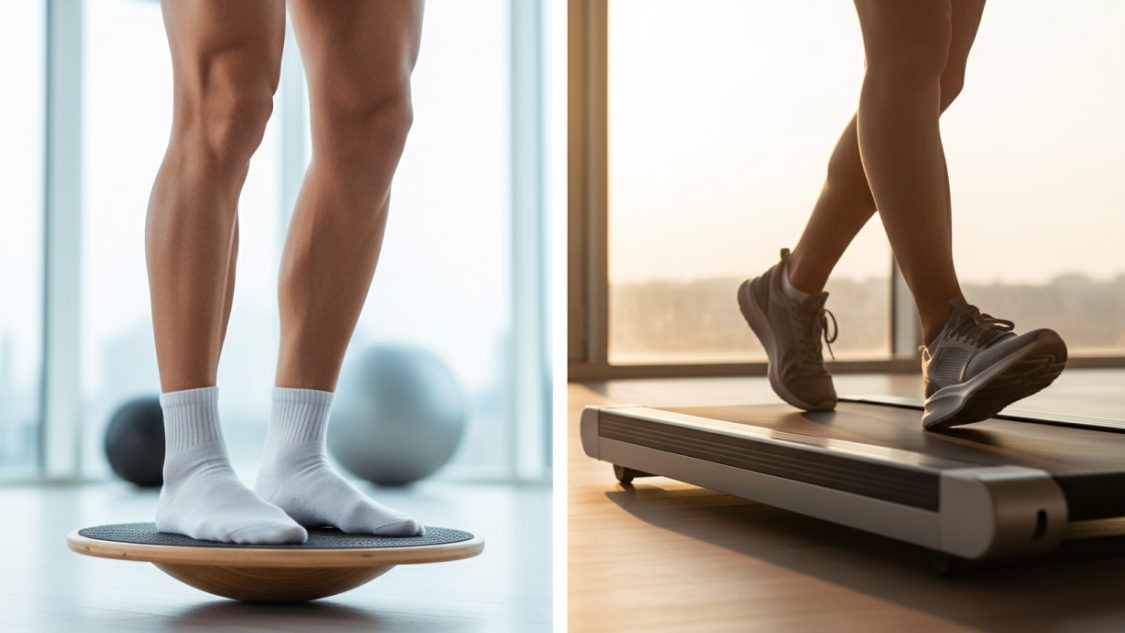
Basically, a balance board is a fitness and training tool. This machine usually consists of a flat platform placed over a rounded base. It creates an unstable surface. When you stand on the board, your body automatically adjusts its posture. This tool's working principle activates core muscles, leg muscles, and stabilizing joints. These constant micro-adjustments train your balance system, improve posture awareness, and strengthen stabilizing muscles without requiring you to take steps or move forward.

Walking Pads
A walking pad was a compact treadmill. It's made for walking indoors in small spaces. This machine has a moving belt and an electric motor. With this powerful motor, you can walk at adjustable speeds. Its working principle is simple: the motor rotates the belt continuously while you walk in place to maintain movement. Your body stays in a natural walking pattern while the machine maintains pace, helping you improve circulation and support steady calorie burn even during work.

In simple terms, a balance board is more about postural control and core engagement, while a walking pad is more about movement, endurance, and daily activity accumulation.
2. Which Helps Burn Fat More Effectively?
When it comes to fat loss, the most important factor is total calorie expenditure over time. This depends on how much you move and how long you can sustain the activity.
A walking pad is very efficient for burning more calories. This tool supports continuous movement. On average, you can burn around 150 to 220 calories per hour while slowly walking. At a faster speed, this number increases up to 300 calories per hour.
On the flip side, the balance board burns fewer calories due to limited movement. You can burn around 80 to 120 calories per hour. Manila, this month, does not focus on fat loss. This position activates deep stabilizing muscles in the back and core. It improves standing posture. It works best as a light movement tool rather than an intense workout. Here’s a simple comparison based on a 1-hour session at moderate intensity:
| Activity | Estimated Calories Burned (1 Hour) |
|---|---|
| Standing on Balance Board | 80–120 kcal |
| Walking Pad (2 mph) | 150–220 kcal |
If your main goal is weight management or reducing body fat over time, the walking pad clearly offers a more efficient and practical approach. The balance board is best for light standing and posture activation.
3. Which Is Better for Standing Desks?
It's very easy to use a computer while walking. There's a little up and down motion, but not to the point of being problematic. For tasks like browsing, writing documents, or checking emails, a keyboard and mouse are usually more than enough. For precise graphic design, video editing, or gaming, you may need to stop. And these tiny walking pads are pretty easy to move. If you want to switch to something else or sit in a chair, you can simply move it out from under the desk when needed.

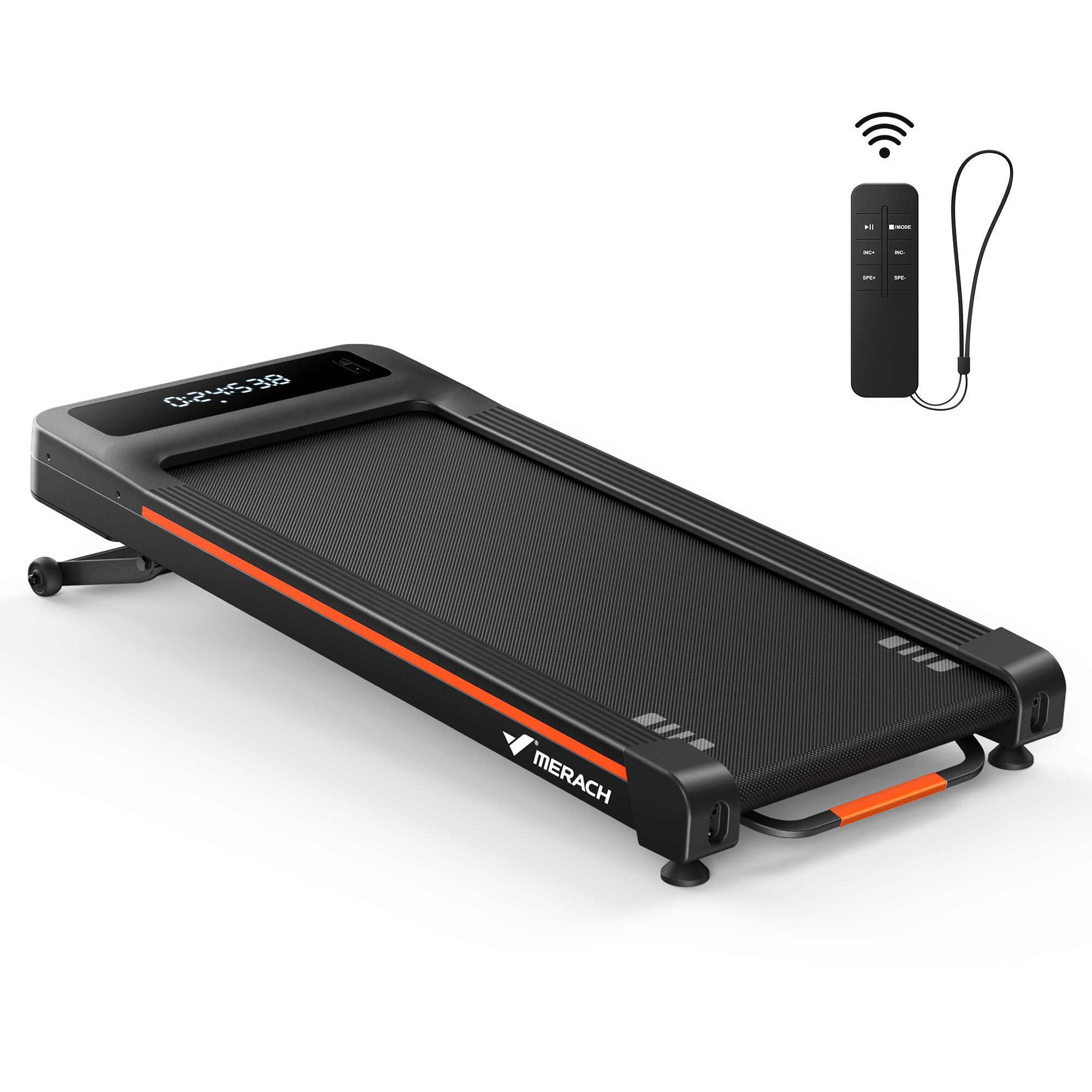
The Merach Novawalk W50 Walking Pad is made for small spaces and offices. It is adorable and convenient. You can upgrade your apartment space without breaking the bank. Furthermore, it's equipped with a 3.5 HP brushless motor. It ensures quiet operation while delivering powerful performance comparable to a treadmill. You can place it easily under a desk without disturbing.
If you've tried balance boards, they're pretty hard to do without holding onto something. This requires a lot of concentration if you're not touching anything. If you're just reading or on a video call, maybe, but it takes a lot of brain power. But with both hands on the mouse and keyboard, it's perfectly possible and easy to work. Compared to walking pads, there's the least up and down motion when stable. Your core might wiggle side-to-side, but your head isn't really moving. So this is probably the easiest for precision work or controlled clicking.
4. Balance Board vs. Walking Pad: Which Offers Better Long-Term Value?
The selection of a balance board and walking pad for a standing desk depends on your daily routine. You need to have a clear answer to this question: Should I buy a balance board or a walking pad? As you already know, both machines have their own features and specifications.
Here are quick tips that enable you to make a final decision.
- To burn calories quickly, you need a walking pad.
- If you want to control posture, go with a balance board.
- If you improve your body balance and core stability, buy a balance board.
- A walking pad designed to build our daily workout habit.
The best choice depends on comfort, space, and budget.
5. FAQs about Balance Boards vs. Walking Pads
To help you make a more confident choice, here are some of the most common real-world questions people ask before buying a balance board or a walking pad.
Q1: Which option is better for working from home?
For most remote workers, a walking pad is the better option. It allows you to stay lightly active while typing, attending meetings, or browsing emails without interrupting your workflow. Over time, it helps reduce long sitting hours and naturally increases daily step count.
A balance board can also be used in a home office, but it works best for short standing periods. It requires constant micro-adjustments, which may feel distracting during focused tasks or long working sessions.
Q2: Which is better for beginners?
A walking pad is generally easier for beginners because it feels similar to natural walking. Most people can start using it immediately with little to no learning curve. A balance board requires more coordination and body awareness. Beginners may need time to adapt to the unstable surface, especially if they are not used to balance training.
Q3: Is a walking pad noisy in an apartment or shared home?
Most walking pads produce low to moderate noise depending on speed and build quality. At slower speeds, noise is usually minimal, but it can increase with faster walking. You can choose a walking pad with a brushless motor to keep quiet during exercise.
6. Conclusion
Well, choosing the best machine depends on multiple factors. You have to check your office and home space.
Always need to clarify your goal, such as weight loss, posture, and light movement. Make sure to prefer your comfort while choosing any machine. Both can improve your health if used daily.