Do you struggle the next morning after a hard workout? Your legs feel heavy when walking downstairs, or your lower back stays tight after deadlifts. That’s why recovery after a workout is necessary.
Currently, vibration plates and massage guns are the dominant tools on the market for muscle relaxation, thanks to their excellent performance. Although both of these could serve as post-workout tools, they work very differently and target different aspects of recovery. The real question is, which one should you pick for your post-workout sessions?
To make it easy, in this article, we will compare the vibration plate and massage gun, break down the key differences and benefits, and determine which is better for you.
1. What’s the Difference Between Vibration Plates and Massage Guns?
Both of these pieces of equipment are popular for post-workout recovery, but their core functionality and working mechanisms differ. One focuses on localized muscle relief, while the other supports full-body circulation, muscle activation, and low-impact recovery sessions.
How a Vibration Plate Helps Recovery?
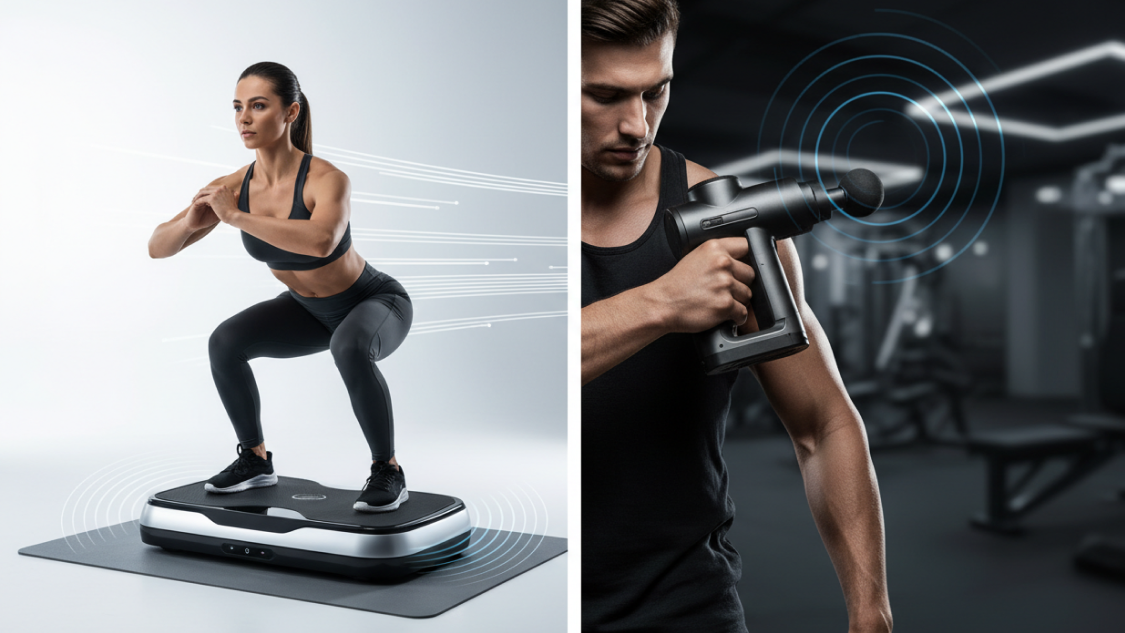
A vibration plate works by generating rapid mechanical vibrations, typically oscillating between 15 and 60 Hz, which travel through the body, whether you stand, sit, or perform any exercise session. It makes your muscles contract and relax rapidly in response to the vibration.

Compared with aggressive recovery tools, vibration plates feel much lower impact. You’re not pressing into sore muscles or forcing deep tissue pressure. It is designed more for full-body recovery rather than targeting one sore spot at a time. Therefore, it is primarily beneficial for:
- Improving circulation: It helps in accelerating the delivery of oxygen and nutrients to fatigued tissues, which helps with lymphatic drainage and reduces post-workout stiffness.
- Increased flexibility: A vibration plate helps loosen post-workout tight fascia and relaxes muscle fibers. It also makes it easy to stretch and maintain flexibility.
- Activation of stabilizer muscles: Standing on the vibration plate engages your core and stabilizer muscles, even during passive recovery use.
How a Massage Gun Helps Recovery?
Unlike a vibration machine, a massage gun is a handheld machine used for recovery from sore muscles through percussion therapy. It works by delivering rapid pulses or repeated pressure into the muscle tissue.

Instead of full-body stimulation, it focuses on targeted muscle relief through deep percussive pressure. This is why massage guns are especially popular for muscle knots and localized soreness. If your calves feel extremely tight after running, your shoulders feel stiff after upper-body training, or your glutes are sore after heavy squats, a massage gun can provide almost immediate relief in those specific areas. So it is more suitable for:
- Breaking up muscle knots: The tight spots in muscle tissue, known as knots, are the areas where muscle fibers get stuck. The rapid percussion of the massage gun helps in breaking up these adhesions and restoring the normal muscle fibers.
- Reduce deep muscle tension: It is the ability to focus directly on problem spots, so it can help reduce that deep muscle tightness that stretching alone sometimes doesn’t fix
However, the experience can feel intense depending on the pressure setting and muscle soreness level. And your arms may get tired during longer sessions because the device has to be held and moved manually. For targeted recovery, though, massage guns are extremely effective.
2. Which Is Better for Muscle Relaxation After Workouts?
After intense workouts, the soreness you feel the next day is often caused by DOMS, which stands for delayed onset muscle soreness. It usually starts around 12 to 24 hours after exercise and can last for several days, depending on workout intensity.
The feeling is different from normal tiredness. Your muscles may feel stiff, tight, or heavy. Severe soreness can also reduce workout consistency because your body feels too fatigued to train again comfortably. Both vibration plates and massage guns can help with it, but they work in different recovery situations.
For Full-Body Soreness
A vibration plate is highly effective for the whole-body DOMS reduction because the vibration affects the entire musculature simultaneously. A session of 10 to 15 minutes after full-body workouts, rowing or cardio sessions, leg day, or high-volume training can meaningfully reduce next-day soreness across multiple muscle groups. Furthermore, because vibration plates are low-impact, they also feel easier on sore muscles compared with aggressive deep tissue tools.

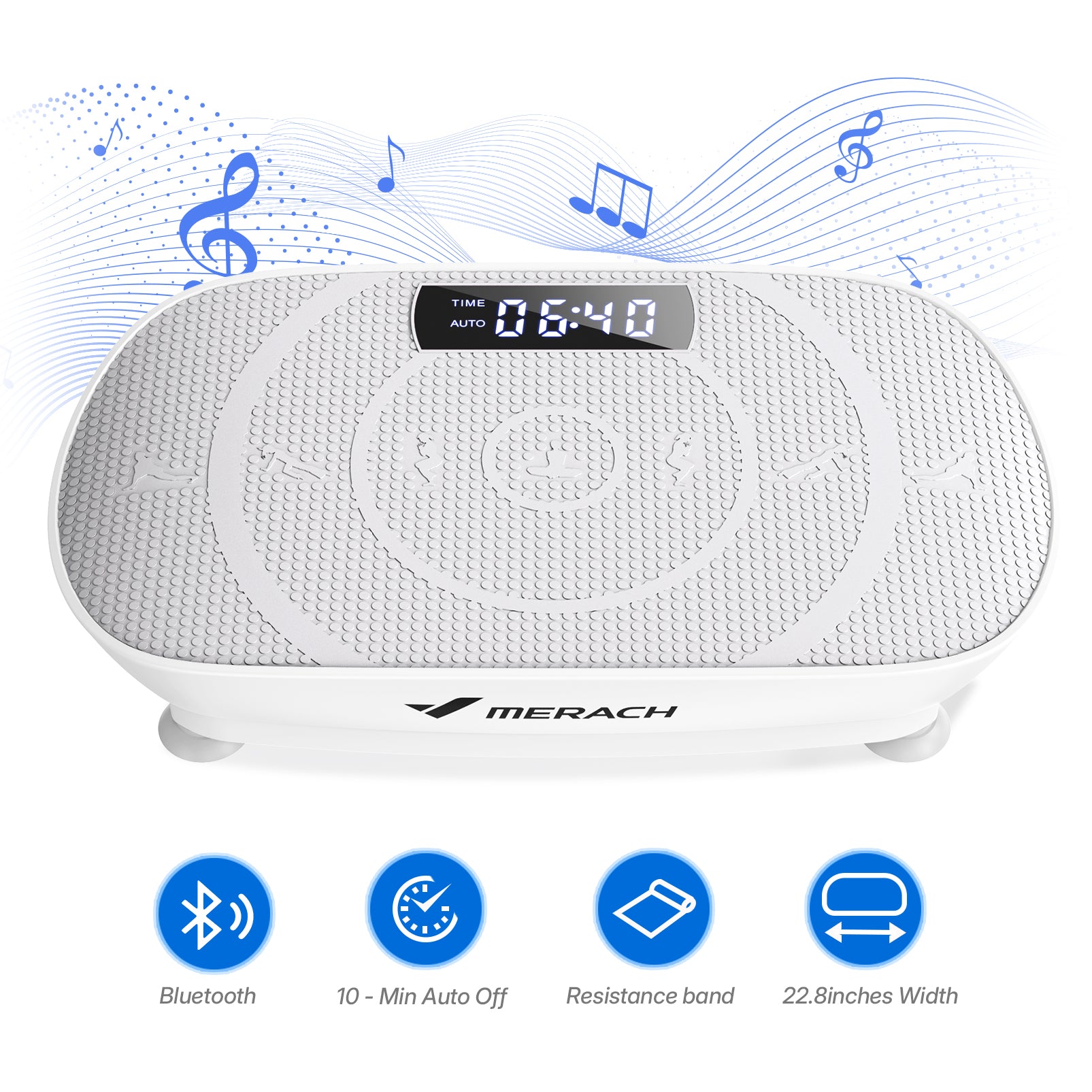
For light daily exercise and relaxation, you can choose the Merach CV30 Pro Whole-body Vibration Plate. It comes with advanced features and accessibility, making it a comfortable option for users of all fitness levels, which is why it is awarded by Shape Magazine as the best vibration plate and a leading choice for 2026. It is compact but sturdy with a weight capacity of 400 lbs., shock-absorbing construction, and a skin-friendly silicon pedal. Furthermore, the high-frequency vibration simulates muscle contractions for the whole body, mainly focusing on your upper body, core, legs, and hips. You can adjust the speed levels according to your personalized workout.
For Target Muscle Tension
On the other hand, massage guns apply concentrated pressure directly into the muscle, which can help relax deep, tight spots much faster than whole-body vibration. You can target your glutes after a heavy squat session, and a massage gun lets you spend concentrated time.
3. Which Is Better for Recovery & Circulation?
When it comes to recovery, vibration plates have an edge. The whole-body muscle contraction stimulated by vibration creates a powerful pumping effect throughout your entire circulatory and lymphatic system, flushing out the metabolic waste from your muscles far more efficiently.
While a massage gun is a good option for local circulation, but limited in systemic impact. It works better for localized pain relief and deep muscle tension. If you have a specific knot in your shoulder, tight calves after running, or soreness concentrated in one muscle group, percussion therapy usually provides faster and more direct relief.
4. Which Is More Suitable for Home Use?
For most home users, the vibration plate is a better option as it doubles as a fitness tool. It allows you to perform lunges, squats, push-ups, planks, and balance exercises on the platform with additional muscle activation. Instead of buying separate recovery and exercise equipment, one machine can support multiple fitness goals while taking up relatively little space.

Whereas a massage gun is recovery-focused only. It requires active use, which means you need to hold the device and move it around your body. Reaching your own back or glutes can be awkward. However, it is highly portable and can be used anywhere, including at the gym, office, or while traveling.
5. Which One Should You Choose: Vibration Plate or Massage Gun?
It is entirely up to your fitness goal to pick one from a vibration plate or a massage gun.
| Feature | Vibration Plate | Massage Gun |
|---|---|---|
| Type of therapy | Whole-body vibration therapy | Percussive deep tissue therapy |
| Muscle engagement | Activates multiple muscle groups at the same time, including core, legs, glutes, and stabilizer muscles | Targets one muscle or a small muscle group at a time |
| Recommended for | Full-body wellness, recovery, circulation, balance training, and light exercise | Localized muscle pain, knots, trigger points, and post-workout soreness |
| Ease of use | Simple to use by standing or exercising on the platform | Requires manual movement and targeting of muscles |
| Time efficiency | Stimulates the whole body in a single 10–15 minute session | Requires separate treatment for each muscle group |
| Impact on joints | Low-impact and joint-friendly, suitable for sensitive knees and older users | Gentle on joints, but pressure may feel intense on sore muscles |
| Suitable users | Beginner-friendly and good for seniors; suitable due to low-impact movement and circulation support | Can be beginner-friendly but requires a learning curve; may feel too aggressive for some seniors or sensitive users |
| Portability | Compact for home use, but not highly portable | Lightweight and travel-friendly |
| Space requirement | Requires small floor space in a room or home gym | Requires almost no storage space |
| Noise level | Usually low to moderate, depending on vibration intensity | Varies by model; some can be loud during use |
| Long-term versatility | Can function as both a recovery and fitness machine | Mostly limited to muscle therapy |
If you want targeted muscle relief or require deep tissue treatment, choose a massage gun. If you want full-body activation, better circulation, and long-term fitness value, a vibration plate is more suitable.
6. FAQs About Vibration Plate vs. Massage Gun
Here are a few questions that will help you to understand both types of equipment better.
Q1: Is a vibration plate better than a massage gun for post-workout recovery?
The vibration plate and a massage gun both serve different purposes and target body muscles differently. The vibration plate focuses on whole-body recovery and improves flexibility, and blood circulation by involving all the muscle groups simultaneously. Whereas a massage gun targets the knots or tight spots.
Q2: How long should I use a vibration plate after a workout?
If you are using a vibration plate for post-recovery, 10 to 15 minutes is the sweet spot. This duration is enough to stimulate circulation, reduce muscle tension, and activate lymphatic drainage without additionally stressing your muscles.
Q3: Who should avoid using a vibration plate?
It is recommended to consult your physician before using a vibration plate. Other than that, it is not recommended for people with any implanted electronic device; people with deep vein thrombosis; pregnant women; if someone has had surgery or a fracture recently; or people with acute inflammation or joint problems.
Q4: Can a massage gun replace foam rolling?
Although foam rolling covers a larger surface area, many people prefer massage guns over foam rolling because of their great percussion depth, which is around 60% of muscle tissue, without requiring the user to support their bodyweight. Many athletes use a massage gun for specific knots and foam rolling for broader muscle groups.
Q5: Is a massage gun safe to use every day?
For most of the people, yes, it is safe to be used as long as you follow proper technique, don’t apply excessive pressure, and limit time on any single muscle group to 12 minutes. Overuse can cause bruising or increased soreness. If you experience pain during use, stop immediately and reassess your technique or pressure level.
Q6: Can you use both the vibration plate and the massage gun?
Yes, you can, as many athletes do. The vibration plate and massage gun complement each other well because they operate at different scales. Both of them can be used after a workout session, mainly for 10 minutes post-workout, before bed, to relax your muscles and relieve soreness.
7. Conclusion
When it comes to choosing between a vibration plate and a massage gun, it is more about purpose than just performance. A massage gun is an excellent option for immediate and targeted relief, while a vibration plate not only helps with the soreness but also supports overall blood circulation, improves balance and flexibility, and ensures muscle activation.
Summarizing it, a massage gun only focuses on a single muscle, while a vibration plate targets multiple systems. For most people who want a long-term wellness tool rather than a single-purpose recovery gadget, a vibration plate simply offers more value.