Is a 20-minute rowing workout enough to achieve a fitness goal? Actually, you don't need a long workout to make progress. What matters more is how you structure those 20 minutes. For beginners, 20 minutes already feels like a challenging rowing session.
That's why this article provides detailed insights about the effectiveness of a 20-minute rowing workout and tips for maximizing the benefits of this time.
1. What Can a 20-Minute Rowing Workout Do for You?
A 20-minute rowing workout seems very short. However, it provides more meaningful fitness benefits. Unlike traditional workouts, rowing combines leg drive and upper-body pulling. During each stroke, your body's major muscle groups move. It includes the quadriceps, back, shoulders, arms, and hamstrings.
The research shows that rowing can activate 80% to 85% of your entire body's muscles. So, your heart and lungs deliver more oxygen. This raises your heart rate quickly and builds muscular endurance. The benefits don't stop here. This exercise also increases calorie burn in the workout and recovery phase.
How Many Calories Does a 20-Minute Rowing Workout Burn?
When it comes to calories burned rowing, your actual calorie expenditure depends mainly on your body weight and workout intensity. Generally, heavier individuals burn more calories. Below is the average calorie amount mentioned for each person's weight.
| Body Weight | Moderate Rowing | Vigorous Rowing | Very Vigorous Rowing |
|---|---|---|---|
| 125 lb (57 kg) | ~100 kcal | ~140 kcal | ~220 kcal |
| 155 lb (70 kg) | ~120 kcal | ~175 kcal | ~270 kcal |
| 185 lb (84 kg) | ~140 kcal | ~210 kcal | ~325 kcal |
| 205 lb (93 kg) | ~155 kcal | ~230 kcal | ~360 kcal |
The estimates are based on the 2024 Adult Compendium's MET values for stationary rowing: 5.0 METs for moderate effort, 7.5 for vigorous effort, and 11.0 for very vigorous effort. Generally, vigorous rowing burns more calories. Furthermore, increased resistance of the rower can further increase calorie burn.
2. How to Do a 20-Minute Rowing Workout?
Your fitness level determines how hard you should make those 20 minutes. Beginners should focus on technique and a steady pace, while intermediate and advanced users can add intervals to increase the challenge. Below, we provide different routines that best match your current fitness level.
20-Minute Rowing Workout for Beginners
If you're new to rowing, you should focus on learning proper technique on the rower. So, the intensity of the 20-minute rower workout is different at this stage. Overall, you have to focus on maintaining good rowing form.
How to do it:
- 3-minute warm-up: Start with three minutes of light rowing. Always choose a comfortable pace and focus on smooth strokes.
- 14-minute main workout: Row at a moderate pace for the next 14 minutes to achieve a steady rhythm. This enables you to maintain proper form and increase your heart rate gradually.
- 3-minute cool-down: In the last 3 minutes, gradually reduce your pace to bring your heart rate down. Once it is completed, spend a few minutes stretching your body parts.

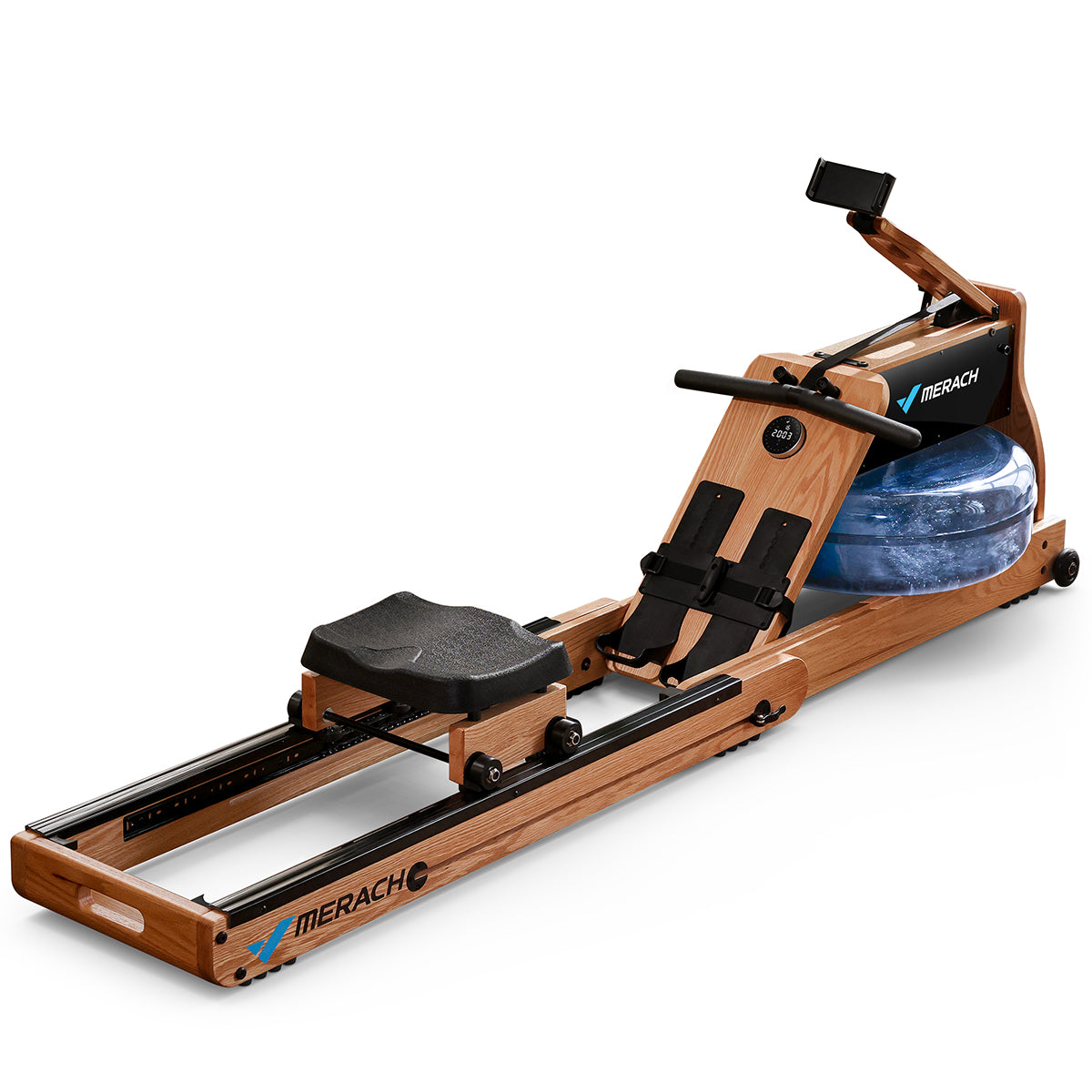
You can easily follow this 20-minute routine at a gym. But what if you want to train at home? Having a rowing machine at home means you can row before work, after work, or whenever you have a free window. For convenient home workouts, the Merach NovaRow R50 Air Rower is a practical option. Its air resistance responds to how hard you row, allowing you to increase the intensity as your fitness improves.
With ergonomic cushioning, it minimizes lower back discomfort and ensures stability. You can start a long rowing session and track it with the LCD. Another noticeable feature is its compact storage. This rower quickly disassembles into two pieces. There are no additional tools for setup or disassembly. With a caster wheel, it ensures easy mobility from room to room. Overall, it is affordable, compact, and easily stored in any place.
20-Minute Rowing Workout for Intermediate Users
If you've already developed a basic rowing routine, you can make it more challenging by adding structured intervals. Below is a detailed overview of a 20-minute rowing workout for an intermediate person.
How to do it:
- 3-minute warm-up: Start with easy rowing and gradually increase your stroke rate.
- Start the pyramid intervals: Start with a hard rowing stroke for 1 minute, 2 minutes, 3 minutes, and 2 minutes. Then, take a 1-minute break and 1 minute of easy rowing between each interval.
- 5-minute build endurance: In the next 5 minutes, continuously stroke at a moderate pace.
- 3-minute tempo challenge: Row at a comfortably hard pace. Your main goal is to maintain it without slowing down.
- 2-minute cool down: Reduce your pace and row easily until your breathing begins to return to normal.
20-Minute Rowing Workout for Advanced Users
Experienced rowers can do HIIT sessions. Short sprints followed by recovery periods create a much higher cardiovascular challenge than steady rowing. This type of workout requires a solid rowing technique.
How to do it:
- 4-minute warm-up: Start with easy rowing and gradually increase your stroke rate.
- Start with sprint intervals: After warming up, start a hard row for 30 seconds. Then row easily for 30–60 seconds. Repeat this cycle for 4 rounds.
- Move into Tabata rowing: Perform 20 seconds of all-out rowing, then recover for 10 seconds. Complete 8 rounds, rest for 2–3 minutes, and repeat if time allows. Tabata training is effective for improving aerobic and anaerobic fitness.
- Finish with a power-endurance block: Alternate 2 minutes of hard rowing with 1 minute of easy rowing for two rounds.
- 2-minute cool down: Gradually reduce your stroke rate. Give your breathing and heart rate time to come down.
3. FAQs about 20-minute Rowing Workout
A 20-minute rowing workout sounds simple, but you may still wonder. Here are answers to some of the most common questions before you start.
Q1: Is it better to row faster or longer?
It depends on your physical condition and fitness goal. Generally, fast rowing enables you to improve speed, power, and cardiovascular fitness. On the other hand, rowing for a longer period at a steady pace burns more total calories. You have to evaluate what you are expecting from this session.
Q2: Can a 20-minute rowing workout help with weight loss?
Yes, it can contribute to weight loss by increasing your daily calorie expenditure. However, rowing alone does not guarantee fat loss. Your overall calorie intake, activity level, sleep, and consistency also matter. A regular 20-minute rowing routine can be an effective part of a sustainable weight-loss plan.
Q3: Is rowing better for cardio or strength?
Rowing can support both cardio and muscular endurance. Your heart rate rises as you maintain the rowing motion, while your legs, back, core, and arms repeatedly produce force. However, if your primary goal is maximum muscle size or strength, rowing should complement rather than replace dedicated strength training.
Q4: What should I do if 20 minutes feels too difficult?
Don't force yourself to maintain a high intensity. Slow your pace, reduce the resistance if your machine allows it, or take a short easy-row recovery period. For beginners, completing 20 minutes with controlled technique is more valuable than finishing the workout at an intensity you cannot sustain.
4. Conclusion
To sum up, the 20-minute rowing workout can significantly improve your heart rate and muscle endurance. However, you need consistency in workouts for the long term. Always keep in mind that you don't achieve a fitness goal in the first 2 to 3 sessions. So, set a small achievable goal from the start.
Track your personal best efforts in rowing, maintain a faster pace, and improve splits. Over time, you can see slight progress. It keeps you engaged and gives you a reason to keep improving. Finally, celebrate consistency rather than perfection.
Apart from safety precautions, make sure to invest in quality equipment. An average-priced machine supports moderate workouts and needs maintenance. Definitely, maintenance needs money, and replacing old parts with expensive ones. Therefore, make sure to invest in a quality machine from the start. Keep the machine's material, their advanced features, and reliability in mind. A wise investment saves you from the headache of replacement.