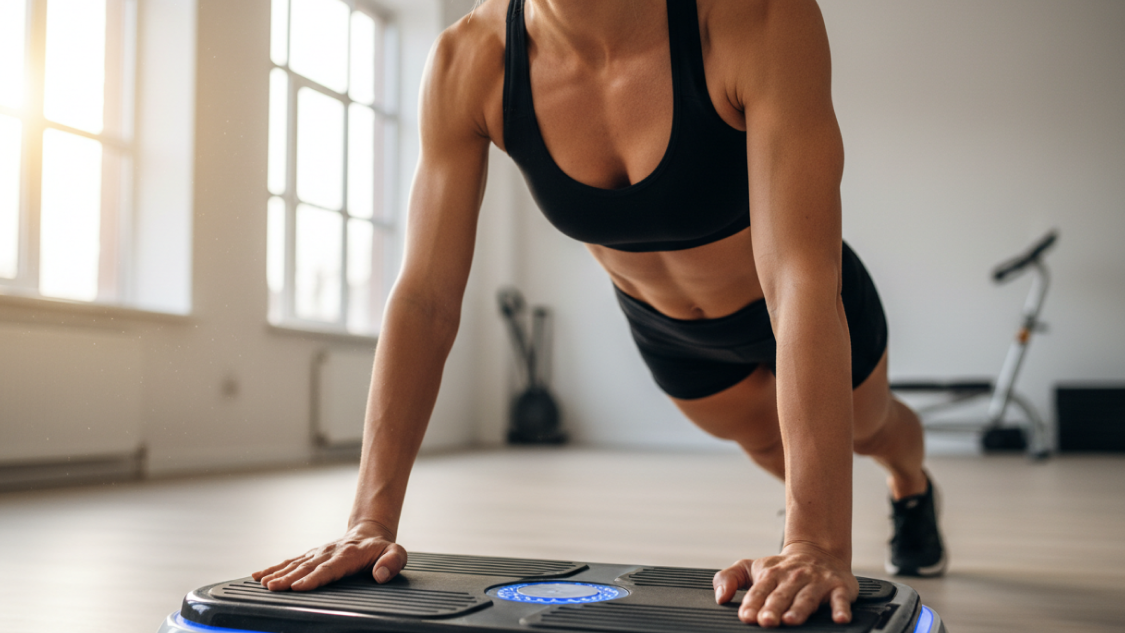
When talking about vibration plate workouts, we usually picture standing exercises for the legs, glutes, or lower body. However, a vibration plate can do much more than that. By placing your hands or arms on the platform, you can turn traditional upper-body movements like push-ups, planks, and shoulder exercises into a more challenging workout.
In this guide, we’ll share 10 effective arm exercises on a vibration plate to help strengthen your arms and shoulders, improve upper-body stability, and tone the appearance of flabby arms. So, keep reading.
1. How to Prepare Before Doing Arm Exercises on Vibration Plates?
Before starting arm exercises on a vibration plate, it's best to prepare yourself. A few adjustments below can make your exercises safer and more productive.
Choose the Right Vibration Setting
If you are new to vibration plate exercises, start with a lower intensity and gradually increase the vibration level as your body adapts. Higher intensity does not always mean better results. The speed that works for you allows you to maintain proper form and control throughout each movement. Adjustable intensity levels make it easier to customize your workout to your fitness level and goals.
Maintain Proper Body Position
As you already know, maintaining correct posture is essential. It helps your target muscles work effectively and improves overall balance during each exercise. Keep your core engaged, shoulders relaxed, and spine in a neutral position. Make sure your wrists remain straight. Avoid bending the arm and wrist excessively.
You have to distribute your body weight. Make sure arms and legs coordinate well to improve stability. You can also stand with a wider stance. But it all depends on what kind of plate you have, and it depends on your body, basically.
Warm Up Your Upper Body
Spend 5–10 minutes preparing your muscles before starting your workout. Do shoulder rolls up and back, and just breathe. Simple movements such as arm circles, shoulder rolls, and wrist rotations can increase blood flow, reduce stiffness, and lower the risk of muscle strains.
2. 10 Arm Exercises on Vibration Plate for Upper-Body Training
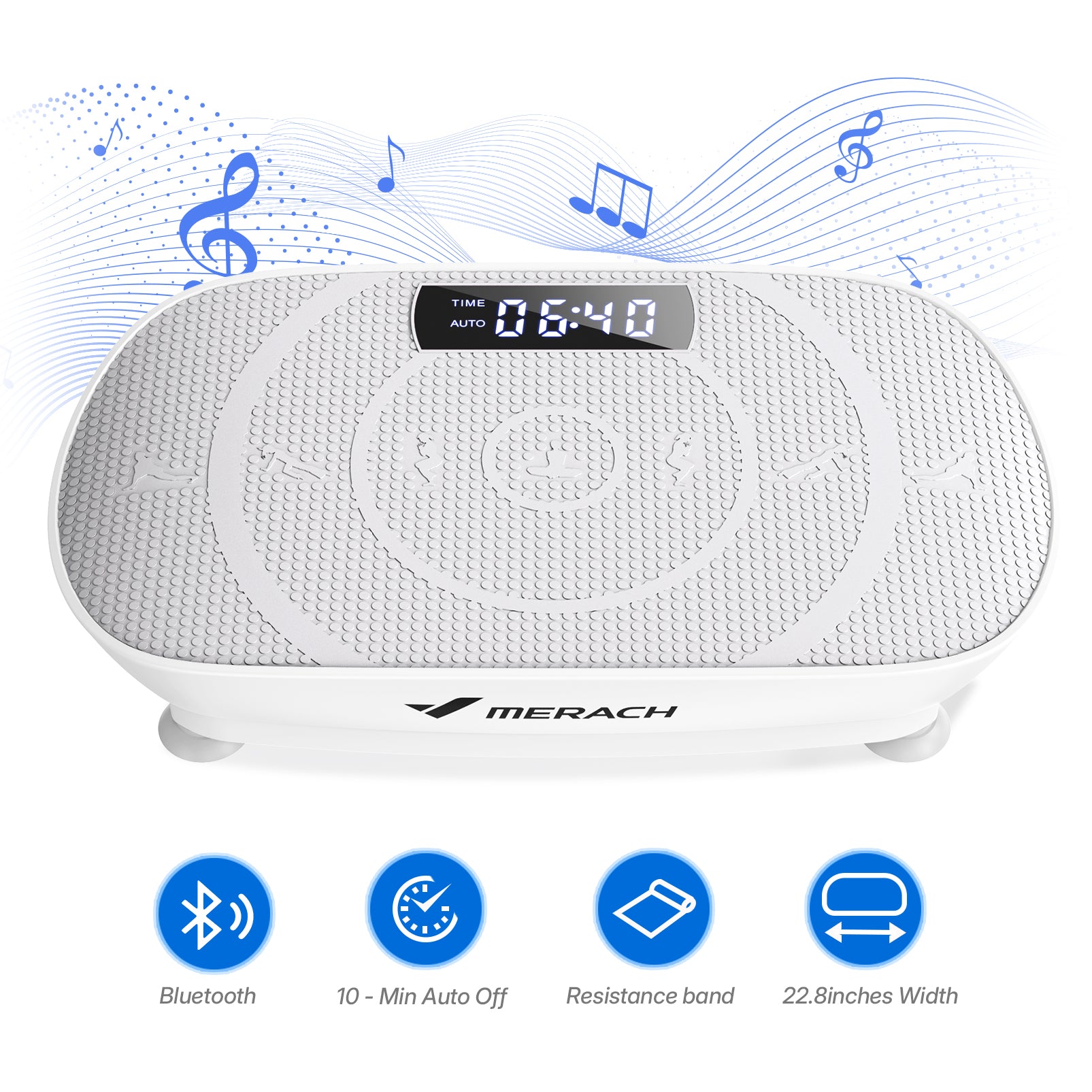
Here is a detailed list of the 10 arm exercises that can be performed on vibration plates. You can add weights or use dumbbells. If you don't want to buy a bunch of extra workout gear. Some vibration plates come with resistance bands, so you can add pulling and strength exercises without purchasing additional accessories. The Merach CV30 Pro Whole Body Vibration Plate comes with resistance bands. With customizable speed, you can adjust it from 1 to 10. Its space-saving design can be easily stored in any place.
For beginners, doing the whole thing without weights is also effective. Grab your vibration plate and let's get going.
1) Elevated Push-Up Hold
Generally, this is an elevated push-up hold that is an isometric exercise. So, it mainly strengthens the chest, shoulders, triceps, and core. You have to hold the position on a vibration plate to improve upper-body endurance. It's best to keep your hips aligned with your shoulders.
Works: Arms, shoulders, chest, and core
How to do it:
- Place both hands on the vibrating plate.
- Then, extend your legs into a high plank position.
- Next, lower your body halfway
- Make sure to hold the position for 15–30 seconds.
- Finally, return to the starting position and repeat 3–5 times.
2) Push-Ups
Push-ups are one of the best upper-body vibration plate exercises for improving pressing strength. Generally, it is designed to build upper-body strength. Furthermore, it improves balance and stability. Lower yourself in a controlled manner and avoid flaring your elbows.
Works: Arms, chest, shoulders, and abs
How to do it:
- Firstly, place your hands slightly wider on the vibration plate.
- Always keep your body in a straight line
- Lower your chest and make sure your elbows reach about 90 degrees.
- Push back to the point where you started.
- Perform it for 8–12 repetitions.
3) Reverse Flies
Reverse flies are a great upper-body exercise for improving shoulder stability and posture. Unlike push-up movements that mainly focus on the front of your upper body, this exercise targets the muscles around your shoulders and upper back. Using a vibration plate adds an extra balance challenge, helping you engage your muscles to maintain control throughout the movement.
Works: Arms, shoulders, and upper back
How to do it:
- Start standing and hold a pair of light dumbbells or resistance bands if available. You can also use water bottles or canned foods.
- Bend your knees, send your hips back, and keep your neck nice and long.
- Extend your arms out to the sides until they are roughly in line with your shoulders. Slowly lower your arms back down.
- Lead with elbows and pinkies, and avoid using momentum or lifting your shoulders toward your ears. Complete 10–15 repetitions.
4) High Plank Shoulder Taps
During this upper-body workout on a vibration plate, you can train your core to resist body rotation. It is especially useful for improving upper-body control during everyday movements.
Works: Shoulders and core
How to do it:
- Always start in a high plank with your hands.
- Gradually lift your right hand and tap your left shoulder.
- Then, return your hand to the plate.
- Repeat with the opposite hand.
- Complete 10–16 taps per side.
5) Reverse Tricep Dips
Mainly, tricep dips isolate the back muscle of your upper arm. This vibration plate upper body workout is designed to strengthen the shoulders and chest. They help improve “bat wings." During tricep dips, you require muscle control throughout the exercise.
Works: Back of arms, shoulders, chest, and core
How to do it:
- Put your hands on the edge of the vibration plate with your wrists under your shoulders and your fingers pointing forward.
- Keep your hips close to the plate but off the floor. Support your body with your arms.
- Extend your legs or bend your knees for an easier variation. When you do legs straight, point your toes and firm up your belly.
- Slowly lower your body by bending your elbows until they are around 90 degrees.
- Push through your palms to return to the starting position. Complete 10–15 repetitions.
6) Elbow Pulls
This exercise focuses on shoulder blade control and upper back engagement. Regular training can help improve rounded shoulders and enhance shoulder stability. This movement focuses on pulling your elbows back and squeezing your shoulder blades together.
Works: Shoulders, upper back, and arms
How to do it:
- Stand on the vibration plate with your feet shoulder-width apart.
- With palms facing forward, reach up through your spine to the crown of your head.
- Pull your elbows at a 90-degree angle while squeezing your shoulder blades together.
- Slowly return to the starting position with shoulders dropped. Repeat for 10–15 repetitions.
7) Row Pulls
Standing rows are an excellent pulling exercise to balance out push-based movements like push-ups. By pulling your elbows backward and squeezing your shoulder blades together, this exercise helps strengthen your upper body while improving posture and shoulder stability.
Works: Upper back and shoulders
How to do it:
- Stand on the vibration plate with your feet hip-width apart. And just row.
- Elbows pull straight back. As you pull your elbows back, think of squeezing a pencil between your shoulder blades.
- Slowly extend your arms forward. Repeat for 10–15 repetitions.
- Focus on moving your elbows backward rather than pulling with your hands.
8) Seated Band Lat Pulldown
The seated band lat pulldown strengthens your back while also engaging your arms and shoulders. By pulling the band downward with control, you activate the muscles that help support better posture and upper-body stability. If you don’t have a resistance band, you can still practice the same movement pattern without equipment. Practice proper form before adding resistance.
Works: Upper back, shoulders, arms, and core
How to do it:
- Sit on the vibration plate with the core engaged.
- Hold the resistance band up. Pull it down just like you're doing that lat machine. If you don’t have a resistance band, extend your arms overhead. And pull your elbows down toward your sides.
- Slowly extend your arms back up. Complete 10–15 repetitions.
9) Alternating Hand Plank
You can perform this upper body vibration plate exercise to improve shoulder strength and core stability. Furthermore, it enables you to switch between forearm and high plank positions.
Works: Arms, shoulders, chest, and abs
How to do it:
- Start in a forearm plank.
- Then, gently press one hand into the vibration plate.
- Raise into a high plank.
- Next, lower back into the forearm plank.
- You have to perform it for 8–12 repetitions.
10) Squat + Sunrise Arms
Squat + Sunrise Arms is a full-body movement that combines a lower-body squat with an overhead arm raise. Although the theme is upper-body arms, we still acknowledge the lymph movement in the lower body.
Works: Arms, shoulders, legs, glutes, and core
How to do it:
- Stand on the vibration plate and slowly go down into a squat
- Up into a sunrise. Raise your arms overhead in a smooth motion. Fully extend your arms at the top.
- Then lower into a squat position again while bringing your arms down in front of your body.
- Repeat for 10–15 repetitions.
3. FAQs about Arm Exercises on Vibration Plates
After learning these arm exercises on a vibration plate, you may still have questions. Below are answers to some of the most common questions about vibration plate arm workouts.
Q1: How long should you use a vibration plate for arm exercises?
For beginners, 10–15 minutes per session is usually enough to get started. You can gradually increase the duration as your body adapts. A short, proper vibration plate workout performed regularly can support better results than occasional long sessions.
Q2: What are the best vibration plate exercises for flabby arms?
Exercises that target the back and front of your arms are most effective for improving arm strength and definition. For example, triceps dips, push-ups, standing rows, reverse flies, and so on. Visible changes usually come from a combination of resistance training, regular exercise, and a balanced diet.
Q3: Can you use a vibration plate every day?
Yes, you can use it every day with proper technique. It is provided that the sessions are moderate. As a beginner, you should start with 10–15 minutes at a low intensity. Then, gradually increase the duration as your body adapts.
4. Conclusion
To sum up, the 10 best arm exercises on a vibration plate improve muscle activation. You have to follow some tips to maximize the benefit from these exercises. First of all, always focus on controlled movements instead of rushing.
Once your body is stable, then gradually progress to more challenging exercises. During this process, make sure to take proper time for recovery. You have to give your muscles enough time to repair and stay hydrated. Always eat a balanced diet with protein. Overall, it supports muscle growth and recovery.