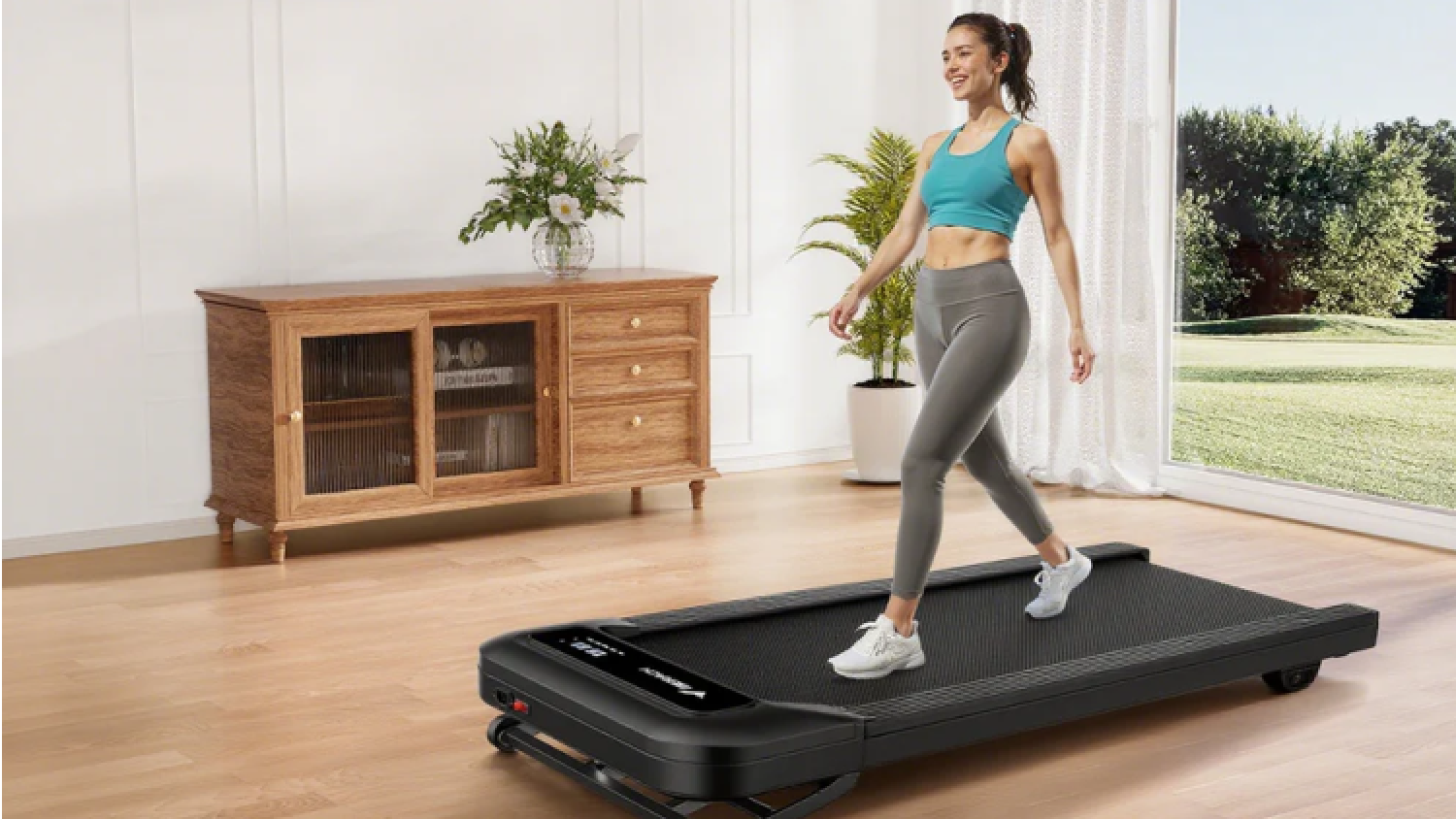
Walking is an accessible and convenient way to exercise. Therefore, many people set a fitness goal of walking 10,000 steps every day. But what if we can't go out for a walk due to weather conditions or lack of time? Treadmills are useful in such situations and can even achieve more effective exercise results in a shorter time.
So, how many steps are in 30 minutes on the treadmill? And how long do you need to walk to reach 10,000 steps? In this guide, we’ll break down how many steps you can expect at different treadmill speeds, how long it takes to reach 10k steps, and practical tips to help you achieve your daily step goal. Get ready to transform your health!
1. How Many Steps Are in 30 Minutes on a Treadmill?
For common walking speeds, walking on a treadmill for 30 minutes is roughly equal to 2,700 steps. The faster you walk, the more steps you'll usually take. It also depends mainly on your walking speed and stride length.
For example, if you walk at speed 3 for 30 minutes, you can expect roughly 2,700–3,000 steps. At speed 4, that increases to around 3,300–3,600 steps. If you increase the speed to 5 MPH, you may reach approximately 4,000–4,500 steps, although this pace is closer to running for many people. Here's a rough idea of what 30 minutes looks like at different speeds:
| Speed | Approx. Steps in 30 Minutes |
|---|---|
| 2.5 MPH | 2,400–2,700 |
| 3.0 MPH | 2,700–3,000 |
| 3.5 MPH | 3,000–3,300 |
| 4.0 MPH | 3,300–3,600 |
| 4.5 MPH | 3,600–4,050 |
| 5.0 MPH | 4,050–4,500 |
These numbers are estimates, not fixed step counts. Your actual number may be higher or lower depending on your height, stride length, walking speed, and how accurately your device tracks treadmill steps. Taller people generally take fewer steps to cover the same distance, while shorter people tend to take more.
What about incline? It doesn't necessarily increase the number of steps you take. The incline mainly increases workout intensity, heart rate, and energy expenditure. So, if your primary goal is increasing steps, focus on your speed and total walking time.
2. How Long Does It Take to Walk 10,000 Steps on a Treadmill?
The 10,000-step goal became popular as a simple daily activity target after being introduced in Japan in the 1960s. While 10,000 steps is not a requirement for everyone, it remains a practical goal that encourages people to move more throughout the day. For many people, reaching 10,000 steps can help increase daily activity, support cardiovascular health, and contribute to weight management when combined with a balanced lifestyle.
So, how long does it take to walk 10,000 steps on a treadmill? As we discussed before, 30 minutes on a treadmill gives you around 2,700–3,600 steps. Reaching 10,000 steps will naturally take longer. For most people, 10,000 steps on a treadmill takes about 80–110 minutes. But it is uncertain because several factors influence the time it takes to reach this goal. Understanding these variables will help you accurately estimate your workout duration and plan your fitness schedule more effectively.
Personal Factors
- Stride length: Tall people or those with long legs generally have a longer stride. It means fewer steps a mile and a faster way to achieve 10,000 steps than a person with a shorter stride.
- Walking speed: It’s the most obvious factor. You will reach 10,000 steps in a lot less time with a brisk walk as compared to a stroll.
- Fitness level: Fitness level determines the duration you will be able to comfortably exercise at a given speed and level of intensity. When beginning, you may have to take a step-by-step approach, first having a retarded performance and then increasing the speed as your ability develops.
Treadmill Settings
- Speed: The rate of a treadmill will have a direct effect on time. The majority of treadmills use miles per hour (MPH) or kilometers per hour (KPH). Vary the speed to see what suits your fitness level and fitness objectives.
- Incline: This does not relate to any increase or decrease in step count by itself, but the intensity of your workout is greatly amplified. Walking on the inclined treadmill uses more muscles and increases heart rate, making the exercise more rigorous.

Time Calculation Formula
To give you a clearer idea, here's an average time calculation for walking 10,000 steps at different paces. However, these are estimates, and your actual time may vary based on your stride length and other factors.
| Pace (MPH) | Steps/Min | Time (Min) |
|---|---|---|
| 2.5 | 80-90 | 110-125 |
| 3.0 | 90-100 | 100-110 |
| 3.5 | 100-110 | 90-100 |
| 4.0 | 110-120 | 80-90 |
NOTE: This table offers a rough estimate, but the time can vary depending on your stride length and walking intensity.
For most of us, a fast walk of 3.0 to 3.5 MPH will be a great beginning to reach the 10,000-step goal effectively. This frequency is hard enough to do cardiovascular training without being so strenuous. If you're new to treadmills, it is better to begin at 2.5 MPH and then increase your pace as your stamina enhances. Once you have adapted to the current treadmill exercise intensity, think of putting a slight gradient to make the intensity get higher to burn more calories.
- Beginner: 2.5-3.0 MPH with a 1-2% incline
- Intermediate: 3.5 MPH with a 2-4% incline
- Advanced: 4.0 MPH with a 5-7% incline
3. How to Get 10,000 Steps a Day on a Treadmill Easily?
Walking for 80–110 minutes at once isn't practical for everyone. You can split your 10,000 treadmill steps into shorter sessions instead. The key is to make your routine easier to maintain by adjusting your walking schedule, speed, and environment. Here are some practical tips to help you reach your step goal more consistently.
Split Tasks
For beginners, it can be difficult to complete 10,000 steps on a treadmill at one time. Break your goal into several shorter, manageable sessions throughout the day. For example, 20–30 minutes of treadmill walking after waking up, 15–30 minutes while taking a break from work, and a longer walking session while watching TV or listening to a podcast. Several shorter walks throughout the day can add up to the same step goal while reducing fatigue.
Diverse training
Try different speeds, inclines, and even backward walking. Most treadmills come with exercise modes, which can be used to vary exercise. You can also try walking intervals. Instead of walking at the same speed for 90 minutes, try alternating between comfortable walking and faster intervals. This can make longer sessions easier and help prevent boredom.
Combine entertainment
One of the biggest challenges of completing 10,000 treadmill steps is staying motivated during longer sessions. Adding entertainment can make the time pass more quickly. Distract yourself with podcasts, audiobooks, music, or your favorite TV shows. A quiet walking pad or treadmill can also make it easier to combine walking with work or entertainment.
Track Your Progress
Tracking your steps is a powerful way to stay motivated and monitor your progress towards your 10,000-step goal. You can use smartwatches such as Apple Watch or Fitbit and smartphone fitness apps to monitor fitness statistics and your daily step count.
By combining these tips with effective treadmill workouts, you'll find that reaching your 10,000-step goal becomes a natural and enjoyable part of your healthy lifestyle. It is best viewed as a daily activity target rather than a requirement.
4. FAQs about 10k Steps on Treadmill
Here are answers to some common questions you might have about tracking steps and optimizing your workouts on a treadmill.
Q1: Is 10,000 steps on a treadmill the same as 10,000 steps outdoors?
For step count, 10,000 steps is still 10,000 steps, whether you walk on a treadmill or outdoors. The main difference is how you move. Outdoor walking naturally includes changes in terrain, turns, wind, and surface, while a treadmill for home provides a more consistent pace and surface.
Q2: How many calories do you burn walking 10,000 steps on a treadmill?
When considering calories burned on treadmill, speed and incline are two of the biggest factors you can adjust. On average, most people burn around 300–500 calories after completing 10,000 treadmill steps. A heavier person or someone walking at a faster speed or with an incline may burn more. For a more efficient workout, try maintaining a steady walking pace with a slight incline while keeping a consistent routine.
Q3: Does walking on a treadmill burn the same calories as walking outdoors?
Generally, walking at the same pace and incline will burn a similar number of calories whether you're indoors or out. However, outdoor walking might slightly increase calorie expenditure due to factors like wind resistance, varied terrain, and the need to propel yourself forward against external forces. On a treadmill, you can compensate for this by increasing the incline, which significantly boosts calorie burn and engages different muscle groups.
For an average adult, walking at a brisk pace of 3.5 MPH on a flat surface burns approximately 250–350 calories per hour. To simulate outdoor walking conditions and increase the intensity, you can increase the incline to just 1–2% on a treadmill, leading to a higher calorie burn.
Q4: How many miles is 10,000 steps on a treadmill?
It depends on your stride length. Based on an average stride length of about 2.5 feet per step, 10,000 steps on a treadmill is roughly equivalent to 4 to 5 miles. If you have a longer stride, 10,000 steps might cover a bit more distance.
Q5: How long to walk 5,000 steps on a treadmill?
Walking 5,000 steps on a treadmill will take approximately half the time it takes to walk 10,000 steps, assuming a consistent pace.
- At speed 3.0: Approximately 50 to 55 minutes.
- At speed 4.0: Approximately 40 to 45 minutes.
The actual time will depend on your specific walking speed and stride length.
5. Conclusion
Reaching your 10,000-step-a-day goal, whether outdoors or on a treadmill, is a fantastic way to boost your overall health and well-being. The treadmill offers a convenient, controlled, and joint-friendly environment to consistently hit your targets, making it an invaluable tool in your fitness arsenal.
Leverage tracking technologies like the Merach app and smartwatches, and implement practical tips for integrating more movement into your day.