Have you ever finished a workout feeling great, only to wake up the next morning with sore legs or stiff shoulders? This often appears when you start a new exercise and increase its intensity. So, how can you get rid of this discomfort and support muscle recovery?
In this article, we'll lead you through 10 practical ways to help your muscles relax and your joints move better, focusing on the five most common areas where people hold tension: the neck, shoulders, lower back, hips, and hamstrings. The goal is to stretch and release tension in each one of these areas.
1. Why Do Your Muscles Get Sore After a Workout?
Muscle soreness doesn't always happen because you "worked out too hard." A new movement, a sudden increase in training, or exercises that place your muscles under unfamiliar stress can all play a role.
This feeling, known as delayed-onset muscle soreness, or DOMS, is usually caused by resistance training or just a novel stimulus in general. You may not feel this much immediately after your workout. However, it can become noticeable within 12–24 hours and often peaks around 24–72 hours.
Studies show that training a muscle while it's still sore can reduce the activation of the desired muscle, reduce the force capacity of the muscle by up to 50%, and negatively interfere with the recovery process. Therefore, it's vital to take the necessary steps in order to minimize post-workout soreness and speed up the muscle recovery process.
2. How to Get Rid of Sore Muscles at Home? 10 Practical Ways
Usually, muscle soreness takes time to improve. Although some suggestions are to take ice baths after your workout, this actually isn't the best advice to take. Although ice baths may slightly help with muscle soreness, they've also been shown to hinder muscle growth and strength by interfering with the muscle recovery process. So what exactly can you do? Well, aside from the general recommendations of taking adequate protein and getting enough sleep, there are 10 ways you can do it at home.
1) Upper Trap Stretch
We're going to get started in the neck with an upper trap stretch. This is probably the most common area where people hold tension. If your neck and shoulders feel tight after a workout or a long day at your desk, this simple stretch can help release some of that tension.
How to do it:
- Place your right hand behind your lower back to keep your right shoulder down.
- Slowly tilt your left ear toward your left shoulder.
- Place your left hand on top of your head and gently add a little pressure until you get a good stretch through the top of the neck and the top of the shoulder.
- Hold for about 25 seconds, then switch sides.
2) Chest Stretch
This exercise is going to be for your chest. A lot of people, especially if you have a desk job, spend a lot of time with their arms in front of them, and the chest gets tight and the shoulders round forward. It creates some posture problems and some neck problems. This is a good way to stretch out of that.
How to do it:
- Stand beside a wall and place your right hand behind you against it.
- Slowly rotate your body away from the wall until you get a good stretch right through the front of the chest, right through that kind of right pec, and into that right shoulder area.
- Hold for about 25 seconds, then switch sides. The left hand reaches back behind.
- Rotate your body away from the wall until you get a good stretch right here through the front of the chest.
3) Standing Side Bends
This is an easy full-body stretch focusing on the lats and then down into the lower back a little bit. Those lats, if they get tight, can also cause those shoulders to round forward and affect posture. So, this is a great way to just stretch those out to release that tension through the entire lateral side of your body. You can do it standing up, making it a convenient option when you don't want to get down on the floor.
How to do it:
- Feet are shoulder-width apart, with your right hand.
- Reach up and over your head, and then as far over towards that wall as you can comfortably until you get a good stretch through the entire right side of the body.
- Hold that for about 5 to 10 seconds, and then repeat it over here to the left side as well.
- Continue alternating for about 50 seconds.
4) Standing Hip Circles
This stretch introduces some active hip mobility with this one. And when they are not very mobile, when they're lacking that mobility and range of motion, oftentimes that carries into other joints, specifically the knees and the lower back. And so the more mobility we can work through the hips, the better those other areas tend to feel. So this is a simple way that you can do that.
How to do it:
- Lift the knee up, then rotate the knee out, and then bring the foot down.
- Make a controlled circle with your hip, moving forward and then backward.
- You can go forward, and then you can go backwards.
- Repeat on the other side and continue alternating.
5) Cat-Cow Stretch
After this, we're going to transition down to the floor. You should prepare a mat. Cat-cows are just a great way to work mobility throughout your entire spine. We kind of get into the extremes of each of these motions as we work through flexion and extension. Just a great way to loosen it up basically from your neck all the way down to your hips, all the way down to your tailbone.
How to do it:
- Start on your hands and knees.
- Tuck your chin toward your chest and arch your entire back up towards the ceiling until you just get a good flexion stretch throughout the entire spine.
- Then reverse that. Let your stomach and your torso fall towards the ground as your head looks up towards the wall.
- Hold for another 3–5 seconds, then repeat.
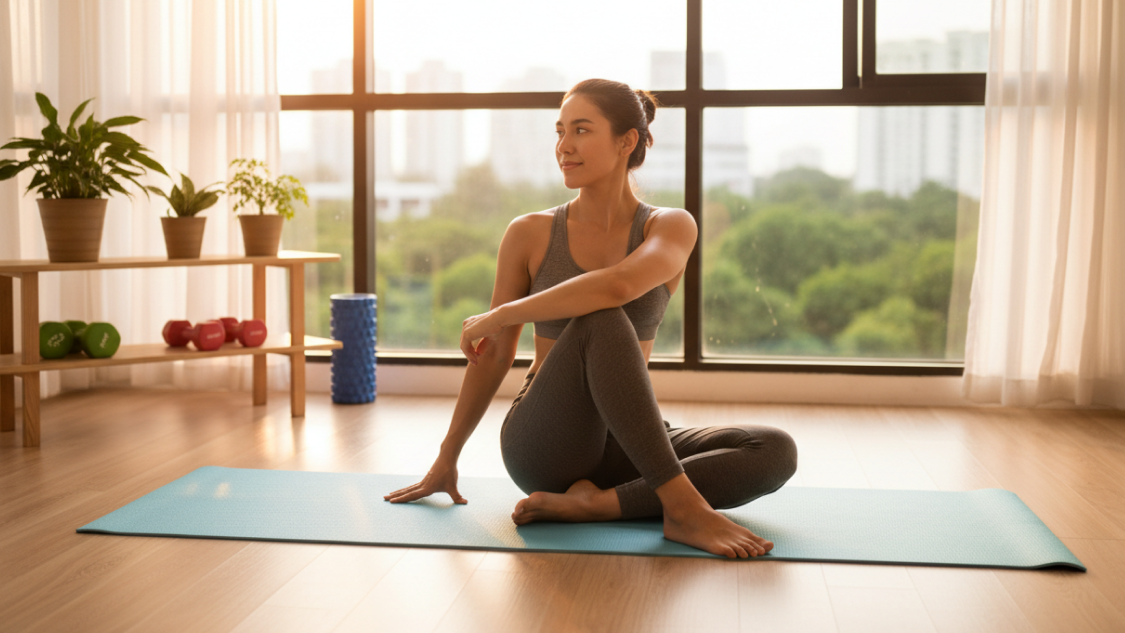
6) 90-90 Hip Rotators
This is also a great way we can work through a little more mobility in those hips, specifically in the hip rotation range of motion. Go through as much range of motion as you have available. If it's painful, you've pushed a little too far; just back off of it a little bit.
How to do it:
- Sit down with your feet and knees wider than your hips.
- Go to the left until that left knee is on the ground, and then the right knee is on the ground.
- And then reverse back this way. Alternate between those two motions.
7) Supine Figure 4 Stretch
The figure 4 stretch is a good choice when your glutes and outer hips feel tight after a lower-body workout. Because you do it lying on your back, you can control the stretch without putting much weight on your joints.
How to do it:
- Lie on your back. Cross your right foot over your left knee.
- Grab behind your left knee and pull it up towards your chest until you get a good stretch in your right hip.
- Hold for 10–15 seconds, then switch sides.
- The left ankle crosses over the right knee. Grab right behind the right knee. Pull that up towards your chest until you get a good stretch in that left hip.
8) Seated Hamstring Stretch
Hamstrings often feel tight after exercises such as squats, lunges, or cycling. This seated stretch lets you gently work on the back of your legs while also giving your lower back some movement.
How to do it:
- Sit down with both your knees extended.
- Then fold forward until you get just a really good stretch through those hamstring muscles, even up into that lower back.
- If you want to bias the stretch to your hamstrings more, keep your back straight and then try to lean forward.
- Reach both hands to the left side, then both hands to the right side to vary where you feel that stretch and move that stretch into some different areas.
9) Double Knee to Chest Stretch
If your lower back and hips feel tight after a workout, bringing both knees toward your chest can provide a gentle way to move and relax these areas. It is especially convenient as a final stretch because you can stay lying on the floor.
How to do it:
- Lie down on your back. Grab both of your knees and pull them right into your chest until you get a good stretch through your lower back.
- Hold for five, then relax. And then pull again.
- You can also gently move both knees toward one shoulder and then the other to change the stretch.
10) Self-Myofascial Release
Self-myofascial release, most commonly done in the form of foam rolling, has become increasingly popular in recent years. Aside from its positive effect on improving mobility, it seems to also be an effective way of reducing muscle soreness. Although research is still lacking, of the four available studies that have directly analyzed the effect of foam rolling on muscle soreness, three of them showed a positive effect on reducing muscle soreness and enhancing muscle recovery. This can be useful when you want a simple recovery method at home.
How to do it:
- Place the foam roller under the sore muscle.
- Move slowly over the area for about 30–60 seconds.
- Use moderate pressure that feels tolerable.
- Pause briefly over areas that feel tight.
- Avoid rolling directly over joints, bones, or areas with sharp pain.
3. Simple Tips to Relieve Sore Muscles
If stretching isn't enough, there are several other simple ways to make post-workout soreness more manageable.
Drink Enough Water After Exercise
Once you complete the workout, make sure to drink enough water. Your body needs fluids to support normal physical function and recovery after exercise. Normal sweating during a workout increases your fluid needs. During a longer workout, consider a drink that also provides electrolytes.
Eat Enough Protein and Nutrient-Rich Foods
During workouts, muscles need adequate energy and protein. So, it supports repair and adaptation after exercise. Instead of focusing on one “recovery food,” you need to build meals around protein. It's best to add carbohydrates, fruits or vegetables, and other nutrient-rich foods. Add eggs, Greek yogurt, milk, fish, chicken, and beans to your diet.
Prioritize Quality Sleep & Rest
Some fitness enthusiasts spend most of their time in the gym and disturb their sleeping patterns. As you already know, sleep gives your body time to recover from physical stress. Poor sleep can make exercise feel harder. Later, it may affect how well you perform during your next session. Keep a regular sleep and wake schedule and give yourself enough time to wind down before bed.
Enough Time to Recover
One of the best natural ways to get rid of muscle soreness is to do nothing and take time. DOMS commonly improves within a few days as your muscles adapt and recover.
4. FAQs about Sore Muscles After a Workout
Muscle soreness can leave you wondering whether you should keep exercising, take a rest day, or try another recovery method. Here are some common questions about what to do when your muscles are sore after a workout.
Q1: How long will gym soreness last?
Usually, GM soreness appears several hours after an intense workout. It often becomes strongest within 24–72 hours. Then, it gradually improves over the next few days. Furthermore, the mild soreness may last around 3–5 days. Still, it depends on the workout and your fitness level. If pain is severe, it may be more than normal muscle soreness.
Q2: What's the difference between muscle soreness and an injury?
Normal post-workout soreness usually develops gradually after exercise and improves over time. An injury may cause sharper or more localized pain and can occur suddenly during or shortly after a particular movement. Consider seeking medical attention if you feel severe pain, significant swelling, or unusual weakness.
Q3: What home equipment can help relieve sore muscles?
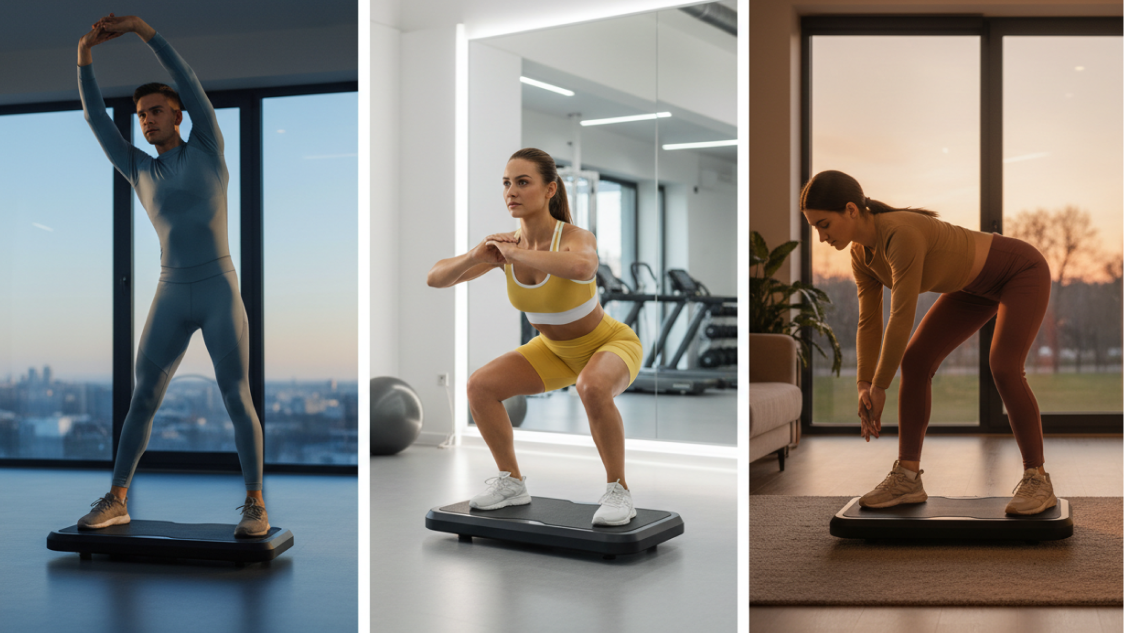
A few simple pieces of home relaxation machines can make your recovery routine more convenient. A foam roller or massage gun can provide targeted pressure to tight muscles, while a heating pad can provide soothing warmth when your muscles feel stiff. A vibration plate is another option if you want to combine gentle movement with vibration. It can be used while standing or during simple movements as part of a light recovery routine.
5. Conclusion
To sum up, getting rid of sore muscles starts with giving your body enough time to recover. Make sure to stop the intense workout. Furthermore, add light activities and proper hydration. Furthermore, you should also pay attention to how your body feels after a light workout.
You can prevent severe muscle soreness by starting new workouts gradually. A vibration plate may be used for light recovery. This is a warm-up tool that prepares your body for a workout and releases muscle tension. This machine vibrates up to 50 times per second. So, it improves full-body blood flow and relieves muscle tension. Overall, this machine is space-saving, easy to store, and provides an interface for quick adjustment.