


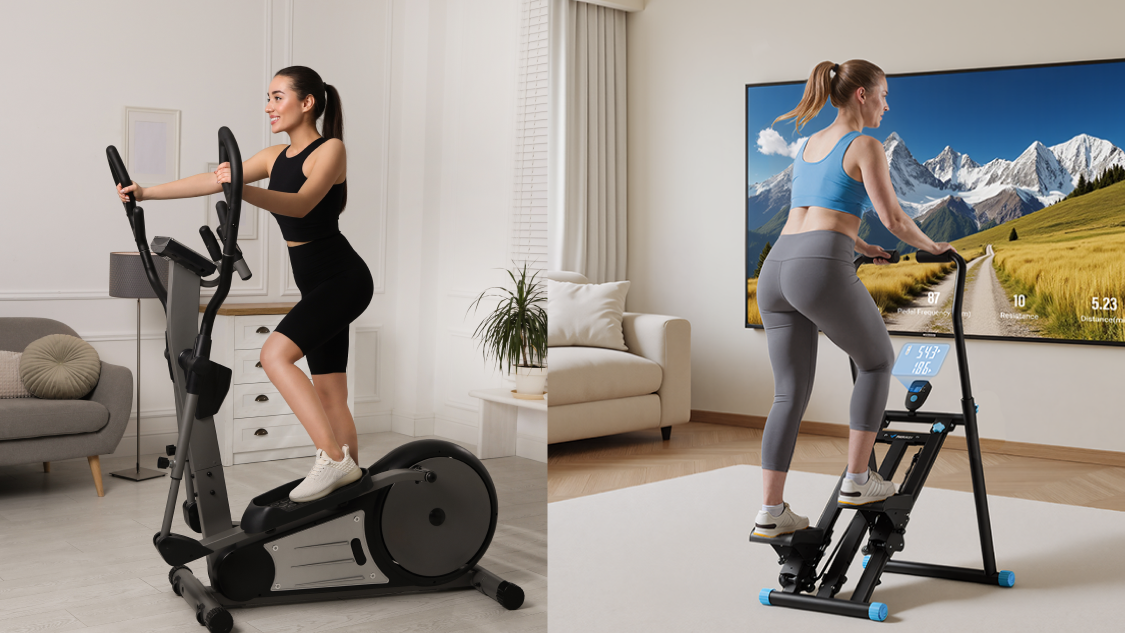
It can be hard to choose the right cardio machine for home use. Elliptical machines and stair steppers are popular choices. Both are decent cardiovascular, calorie-burning, and muscle-toning exercises; however, their construction and motion patterns are rather dissimilar.
In this guide, we’ll break down the key differences in terms of calorie burn, muscle engagement, joint impact, and convenience. Having this understanding can help you choose the right machine to meet your fitness needs.
1. What Are Key Differences Between Elliptical Machines & Stair Steppers?
Elliptical machines provide a smooth pedal stroke with foot pads that move in an oval, or elliptical, motion. They are mostly equipped with moving handles that engage the upper and lower body to perform a complete-body workout. Resistance and incline are adjustable to work various muscle groups or target more fat. Low-impact design is very friendly to the knees, hips, and ankles and is therefore most suitable for rehabilitation or for individuals sensitive to joint stress.
Stair steppers are similar to walking up stairs. Users perform continuous motion by stepping on the pedals or stairs, which primarily works the lower body, improving heart endurance. They are more compact and thus can fit in small spaces. The following table summarizes the key benefits and movement differences to help you visualize the core distinctions:
| Feature | Elliptical Machine | Stair Stepper |
|---|---|---|
| Movement | Smooth, elliptical gliding | Vertical stepping motion |
| Muscle Engagement | Full-body (arms + legs) | Lower body focus (glutes, quads, calves) |
| Impact | Low-impact | Moderate impact |
| Resistance | Adjustable incline & resistance | Adjustable step resistance |
| Space | Larger footprint | Smaller, compact design |
| Noise | Generally quiet | Can be noisier on cheaper models |
| Benefits |
|
|
| Limitations |
|
|
2. Elliptical Machine vs. Stair Stepper: Which Is Better for Weight Loss?
When choosing between an elliptical machine and a stair stepper, one of the biggest concerns is: which one burns more calories and leads to effective weight loss?

In general, elliptical machines tend to burn slightly more calories as both upper and lower parts of the body are in action. The adjustable resistance and slope can also be used to increase intensity and sustain higher heart rates for longer. This total-body engagement helps maintain fat burning and improve metabolic output.
Stair steppers, on the other hand, are better suited as an anaerobic exercise for building leg muscle. So the total calories burned on stair steppers may be slightly lower. To give a clearer picture, here’s an estimate of calorie burn for a 155 lb person during a moderate-to-vigorous workout:
| Workout Type | Intensity | Calories Burned (30 min) |
|---|---|---|
| Elliptical | Level 5–7, ~120 SPM | 260–320 kcal |
| Elliptical (high intensity) | Level 8–12, ~140+ SPM | 320–420 kcal |
| Stair Stepper | Level 4–6, ~60–80 steps/min | 200–260 kcal |
| Stair Stepper | Level 7–10, ~80–100 steps/min | 260–360 kcal |
What does this mean for weight loss? If your goal is maximum calorie burn and efficiency, the elliptical has a slight advantage due to full-body involvement. For example, maintaining a steady pace of 120–140 strides per minute with moderate resistance can significantly elevate heart rate and sustain fat-burning zones.
If you prefer intense lower-body workouts that build muscle while burning calories, the stair stepper is still highly effective.
3. Which One to Choose for Building Muscle?
As noted, stair steppers are effective for building muscle. Does that mean ellipticals don't work as well for building muscle? It depends on whether you want targeted lower-body toning or a more balanced full-body workout.
While the muscle activation is less concentrated than on a stair stepper, the elliptical promotes more balanced full-body development by combining synchronized leg movement with upper-body engagement through the handlebars. It combines cardio and overall muscle conditioning in one workout. In addition, the gentle, smooth sliding motion places less stress on the joints, making it easier and safer for beginners and older adults. They allow for gradual progression in resistance and intensity without placing excessive stress on the knees or hips.
While stair steppers build lower-body muscle more intensely in shorter bursts, they are particularly advantageous for people who want to shape and define their lower-body muscles through high-intensity, anaerobic bursts.

If you want to take advantage of this training style at home, the Merach Folding Vertical Stair Stepper series is a strong option. Its whisper-quiet operation makes it ideal for home environments where noise is a concern. For beginners, the StepMaster Pro offers a 3-level magnetic resistance system, wide pedals for secure footing, and a heavy-duty weight capacity of 330 lbs. The adjustable handlebar height helps maintain a natural posture.
For advanced users who prefer higher intensity and more progressive options, the StepMaster X offers 9 adjustable resistance levels. The more compact structure also makes it well-suited for users who need a space-efficient solution without sacrificing workout intensity.
In summary, both machines can also be used for HIIT. Choose a stair stepper if your priority is lower-body strength and muscle definition. Choose an elliptical if you prefer a full-body workout. In either case, increasing resistance and pace is key to improving both muscle engagement and calorie burn.
4. Elliptical Machine vs. Stair Stepper for Home Use
When choosing between fitness machines for home workouts, storage and noise level are often the most important practical factors. Ellipticals tend to be larger, longer, and wider-footprint machines that require specific floor space in a workout or home gym. They are not as easily moved or stored because of their size and moving parts. Stair steppers, on the other hand, are smaller and lighter, so they can fit into small apartments or spaces with limited space. Most models can be repositioned easily and fit in a closet or corner when not in use.
In terms of noise, ellipticals tend to be quiet because they do not move roughly and use magnetic resistance, making them suitable for shared environments like apartments or living rooms. Stair steppers can be louder, particularly when they have hydraulic systems or are on hard floors. However, one can use a floor mat to reduce vibration and noise.
5. Which Machine Offers Better Long-Term Fitness Results?
Based on the comparisons above, the difference between an elliptical and a stair stepper becomes much clearer. Ellipticals are good all-around exercise equipment for working the whole body and heart with minimal joint stress. This makes them especially effective for sustainable, long-term fitness habits.
Stair steppers are the best for developing lower-body strength and endurance. They can significantly improve muscle tone and calorie efficiency, but they may feel more demanding for frequent, long-duration use.
| Feature | Elliptical Machine | Stair Stepper |
|---|---|---|
| Calorie Burn | Moderate to high, easy to sustain longer sessions | High intensity, more efficient in shorter sessions |
| Muscle Development | Balanced full-body conditioning | Strong lower-body focus (glutes, quads, calves) |
| Joint Impact | Low-impact, joint-friendly | Moderate impact, higher joint load over time |
| Ease of Consistency | Easier to maintain daily routines | More fatiguing, may limit frequency |
| Ideal Users | Very suitable for beginners and seniors | Better for intermediate to advanced users |
| Home Use Practicality | Larger, less portable | Compact, easier to store |
If possible, combining both is ideal. Use the elliptical for steady-state cardio and recovery days and the stair stepper for high-intensity lower-body sessions. This approach helps increase calorie burn, improve muscle definition, and prevent workout plateaus.
6. FAQs about Elliptical Machine vs. Stair Stepper
After going through all the comparisons, you may still have practical concerns. Here are the most relevant answers to help you.
Q1: Which machine is easier to start with if I have no workout experience?
Both the elliptical machines and stair steppers are easy to learn and use. But ellipticals are generally more intuitive for beginners. The motion is smooth and guided, so you can simply step on and start moving without worrying about balance or coordination. Stair steppers require constant stepping, so they can feel more physically demanding at first. If you’re completely new to exercise, an elliptical helps you build confidence and consistency faster.
Q2: What’s a simple beginner routine I won’t quit?
For elliptical:
- 5 minutes of warm-up with low resistance.
- 10–15 minutes at a steady pace with moderate resistance.
- 5-minute cool-down.
For stair stepper:
- 5 minutes of slow-stepping warm-up.
- 10–15 minutes at a steady pace.
- 5-minute cool-down.
If you feel repetitive, you can pair with TV, music, or podcasts. As you improve, you can gradually increase time or add short bursts of higher intensity.
Q3: Is it better to stick to one machine or switch between both?
If you have access to both an elliptical and a stair stepper, switching between them is often the most effective long-term strategy. Interval training increases calorie burn and the efficiency of a workout by varying training intensity. Use the elliptical when you want a longer cardio workout. Use the stair stepper when you want a more intense strength session. This combination not only helps prevent workout boredom but also helps avoid fitness plateaus.
Q4: How long should I use the elliptical machine or the stair stepper for every session?
- For beginners: 20 minutes per session, 3–4 times per week
- For intermediate: 30–45 minutes per session, 4–5 times per week
- For advanced: 45–60 minutes or interval-based sessions
Consistency matters more than time. It’s better to train regularly than to push too hard and stop.
Q5: Should I upgrade later or choose a more advanced machine now?
If you expect your fitness level to improve, it’s often smarter to choose a machine that allows progressive training. Ellipticals already offer adjustable resistance for gradual improvement. Stair steppers can also scale intensity, but higher-end models with more resistance levels provide a better long-term experience.
7. Conclusion
When deciding between an elliptical machine and a stair stepper, it is necessary to make a decision based on your objectives, the space at your disposal, and dedication. For most home users, the smartest approach is to start with the machine that feels more natural and sustainable, then gradually increase intensity or variety as your fitness improves.


