You know those adjustable benches at the gym—they're usually by the dumbbell rack. A lot of beginners are intimidated to use them because they may choose the wrong bench angle, place their feet incorrectly, or lift more weight than they can handle.
Today we're going to be talking about all things bench press, like setup, form, and common mistakes, to use a weight bench safely. So let's do it.
1. What is a Weight Bench?
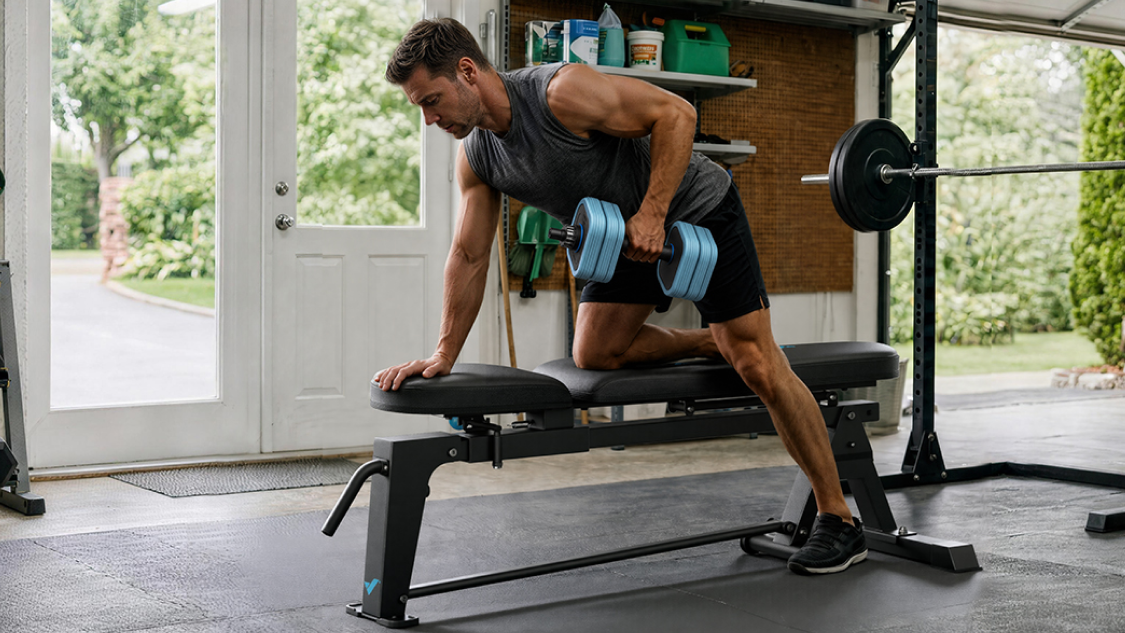
Basically, it is a piece of strength-training equipment. This machine is designed to provide a stable surface for performing resistance exercises with dumbbells and bodyweight. Mainly, it supports your body during exercises. Mostly, the weight benches feature a flat, inclined, and declined backrest. The main difference is how much you can adjust the backrest and how much space and weight they can handle. Here are some common types of weight benches:
- Flat bench: A simple, fixed bench with a level surface. It's mainly used for exercises such as flat dumbbell presses, chest-supported rows, and hip thrusts.
- Adjustable bench: The backrest can be changed between flat and incline positions. It's more versatile and works well for presses, shoulder exercises, rows, and other upper- and lower-body movements.
- Incline bench: Designed primarily for exercises that require an elevated upper body, such as incline dumbbell presses and seated shoulder presses.
- Olympic or heavy-duty bench: Built for heavier barbell training and often used with a rack. It's more common in commercial gyms or dedicated home gyms.
The weight benches we typically use at the gym are usually heavier and more specialized. You may find flat, adjustable, Olympic, and heavy-duty benches for barbells, racks, and other strength-training equipment.

For home workouts, it’s typically used a compact, foldable, adjustable weight bench. It can support multiple exercises without taking up too much space.
2. How to Set Up a Weight Bench Correctly?
Before you explore how to use a workout bench, you need to set up the weight bench properly. A lot of gyms will have a bench that is dedicated to bench press, and they're going to be preset, so you can't really adjust where the J-hooks are, and the bench is going to be fixed. But if you're using an adjustable weight bench, take a few minutes to set it up before your workout.
Choose the Right Weight
It's best to choose a weight that matches your current body strength level. Avoid choosing a load that makes you lose control or change your body position during a repetition.
Adjust the Bench Angle
The next step is to adjust the bench angle. Generally, the flat, incline, and decline positions are common. In the flat position, set the bench to 0° for exercises. Next, you have to adjust the backrest to 30°–45° in the incline position. Furthermore, set the bench to a downward angle between 15° and 30° during the decline position.
Position the Bench Safely
The next step is to place the bench on a non-slip surface before your workout. Make sure to leave enough space around the bench. So you can move it freely without hitting nearby equipment.
3. How to Use a Weight Bench for Beginners?
Once you have made full preparations, let's explore the steps to train your body and get the most from every exercise. Here are the details about how to use a weight bench at home.
Step 1: Get into the Correct Starting Position
In the first step, you need to position your body properly. You can get started by sitting in the middle of the bench before picking up the weights. You have to place both feet flat on the floor. Before lifting, check your position.
- Make sure your chest is lifted.
- Pull your shoulder blades back slightly.
- Brace your core muscles.
- Natural curve in the lower back.
Remember, a correct position improves balance and reduces lower back strain.
Step 2: Lift the Weight into Position
When your body is stable, bring the weight into the starting position. If you're using dumbbells, lift one dumbbell onto each thigh. Then, you can use your legs to help guide them into position. In the case of a barbell, grip the bar evenly and unrack it. Always ensure your wrists are straight and your hands aligned with your forearms.
Step 3: Perform Each Repetition with Full Control
The next step in using a workout bench is to lower the weight slowly until you reach a comfortable range of motion. Afterward, lift it back without using momentum. Be mindful that every repetition should be controlled from start to finish. When you move the weight, follow these:
- Feet firmly planted on the floor.
- Never lift your hips off the bench.
- Move through a full range of motion.
- Focus on the target muscle
Well-controlled repetitions improve your muscle activation and place less stress on your lower back.
Step 4: Maintain Proper Breathing and Body Position
During the workout, take steady breaths continuously. Make sure to inhale as you lower the weight and exhale as you press or lift it. At the same time, keep your body in the same stable position. To maintain your breath, don't
- Hold your breath for multiple repetitions.
- Look around while lifting.
- Twist your hips.
- Let your feet move off the floor.
During this step, you have to maintain the same body posture to prevent any injuries.
Step 5: Finish the Set and Leave the Bench Safely
Once you finish the workout, return the weight with the same control. If you're using a barbell, carefully back it onto the rack before releasing your grip. In the case of dumbbells, make sure to lower your thighs, sit upright, and place them on the floor.
It's ideal to take a few seconds before standing up. If you stand up quickly, you may feel dizziness or loss of balance. Make sure to finish each set with proper body control.
4. What Can You Use a Weight Bench For?
An adjustable weight bench is more than a surface for bench presses. By changing the bench angle, you can use it for upper-body pressing, back exercises, lower-body movements, and glute training. It can also make many dumbbell exercises more stable and easier to perform at home. Here are the common exercises you may perform on a weight bench.
Dumbbell Bench Press
The dumbbell bench press is one of the most impactful upper-body exercises. For this workout, you have to lie flat on the bench with a dumbbell in each hand. Make sure to keep your feet firmly on the floor. Then, press the dumbbells upward. Keep doing it until your arms are fully extended.
After a few minutes, slowly lower them to chest level. This exercise primarily targets the chest, shoulders, and triceps. Furthermore, it also engages your core for stability. Make sure to start with light weights and focus on controlled movement.
Incline Dumbbell Press

Before starting this exercise, it's best to adjust your bench to a 30–45-degree incline. Then, sit back with a dumbbell in each hand. Once your position is settled, press the weights upward. Keep doing it until your arms are straight.
After a few seconds, make sure to lower them slowly and keep your elbows slightly below shoulder level. The incline position targets the upper chest and front shoulders. Furthermore, it helps create balanced chest development. However, beginners should avoid setting the bench too steep. Otherwise, it places stress on the shoulders and reduces chest activation.
Chest-Supported Dumbbell Row
First of all, set the bench to a low incline. Then, make sure to lie face down with your chest supported against the padding. For a few minutes, hold a dumbbell in each hand. This enables your arms to hang naturally.
You can pull the dumbbells toward your ribs. Squeeze your shoulder blades together and lower them under control. This exercise strengthens the lats, rhomboids, trapezius, and rear deltoids. Overall, it reduces stress on the lower back.
Seated Shoulder Press
In this workout, you have to raise the bench to an upright position. Then sit comfortably, holding dumbbells at shoulder height. Make sure to keep your palms facing forward. For the next few minutes, press the weights overhead until your arms are fully extended.
Then, lower them slowly to the starting position. The seated position provides greater stability than standing. Additionally, it makes it easier for beginners to learn proper pressing technique. This exercise improves overhead strength and posture.
Bulgarian Split Squat
For this workout, you have to stand a few feet in front of the bench. Then, place one foot behind you on the bench. Make sure to lower your body so that your front thigh is nearly parallel to the floor.
Finally, push through your front heel to return to the starting position. It is best to perform all repetitions before switching legs. The Bulgarian split squat targets the quadriceps, glutes, hamstrings, and core. Mainly, it improves balance and single-leg strength.
Dumbbell Hip Thrust
First of all, you have to sit on the floor. Make sure your upper back is resting against the edge of the bench. Take a position with a dumbbell across your hips. Then, your next move is to bend your knees. Do it until your feet remain flat on the floor.
Make sure to take a brief pause while squeezing your glutes. Finally, lower your hips slowly. This exercise is highly effective for glutes, hamstrings, and core. Overall, it improves hip power and supports better lower-body performance.
5. Common Mistakes When Using a Weight Bench
There are a few really common mistakes with the weight bench. They can affect your form and make exercises harder to control.
Use Too Much Weight
Lifting more weight than you can control can cause you to rely on momentum or change your body position. Start with a manageable load and increase it gradually as your technique improves.
Choose the Wrong Bench Angle
The bench angle changes how an exercise feels and which muscles do more of the work. For example, setting an incline bench too steep during an incline dumbbell press can shift more of the workload toward your shoulders.
Forget to Lock the Bench
Never start a set before checking the adjustment mechanism. An unlocked backrest or seat can move unexpectedly when you apply force. Make sure every adjustable section is securely locked before you lift.
Lift Your Hips Off the Bench
Many people drive straight up, and then you're going to get that space under your butt. It might give you some leverage, but lifting your hips can make your position unstable. Keep your hips in contact with the bench and your feet firmly planted.
6. FAQs about Using Weight Benches
Choosing and using a weight bench can raise a few practical questions, especially if you're using it at home. Here are answers to the questions that are most likely to come up.
Q1: What type of weight bench is best for beginners?
An adjustable weight bench is usually the most versatile choice for beginners because it allows you to change the backrest angle for flat presses, incline presses, seated shoulder presses, and supported rows. If you're training at home, a foldable design can also save storage space.
Q2: Can I use a weight bench without weights?
Yes. A weight bench can also support bodyweight exercises such as step-ups, Bulgarian split squats, incline push-ups, and hip thrusts. This makes it useful even if you're building a home gym with limited equipment.
Q3: How do I know if my weight bench is set up correctly?
Before starting, check that the bench is on a flat, stable surface, the backrest and seat are securely locked, and the frame does not wobble. You should also have enough space around the bench to move the weights safely. If anything feels unstable, stop and adjust the setup before exercising.
7. Conclusion
To sum up, learning how to use a weight bench correctly can not only make your training more effective but also help prevent injuries. Furthermore, it gives your muscles enough time to recover. As you already know, recovery is an essential part of building strength and improving performance. The recovery period enables you to start intense workouts.