Many exercisers face the same dilemma: Which exercise machine will I actually use the most, and which one will end up collecting dust and taking up space?
When it comes to exercise bikes, choosing between an air bike and a stationary bike can be tricky. They may look similar, but they offer very different workout experiences. So, in this article, we’ll break down the pros and cons of each to help you figure out which one is the better fit for your workout goals and home setup.
1. What Are the Key Differences Between Air Bikes & Stationary Bikes?
So, what really sets these two bikes apart? Let’s look at the key differences.
Muscles Worked
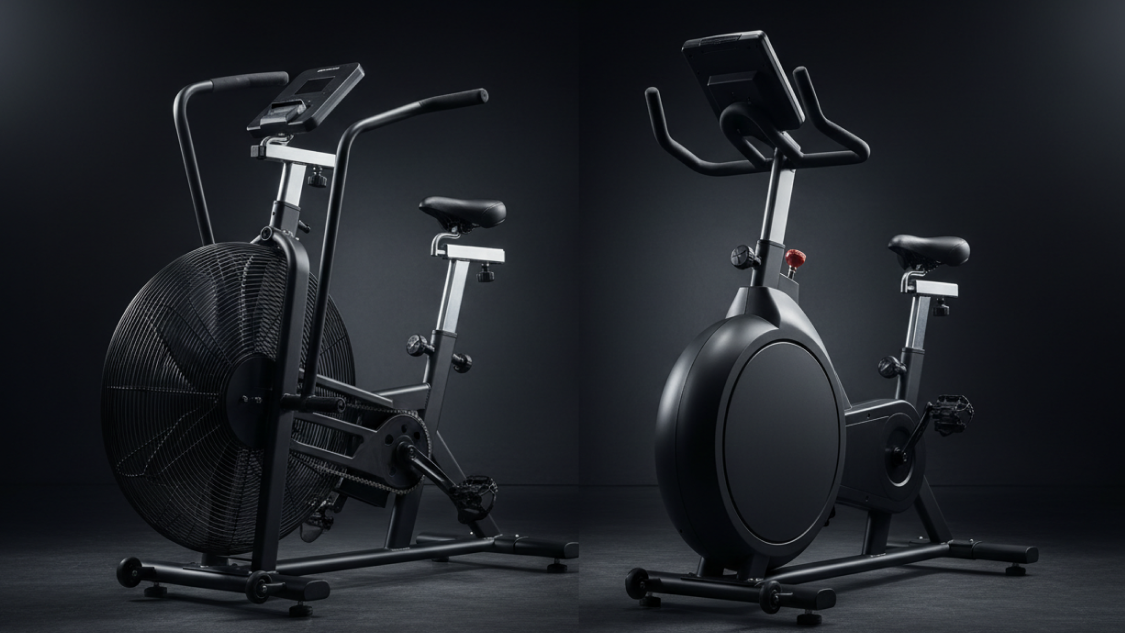
The first and most obvious thing is that, unlike a stationary bike where you're just using your legs, on an air bike you can use your entire body. Because it combines your arms and legs, it’s particularly well suited to HIIT, sprint intervals, and full-body conditioning. This obviously doesn't just result in more muscle activation and greater energy expenditure but also means you're getting a whole-body conditioning workout, as opposed to just from the waist down.
While a stationary bike targets the lower-body muscles. Depending on the model, it may use friction, magnetic, or electromagnetic resistance, allowing you to control the intensity more consistently. It provides a low-impact cardio workout. Therefore, it is better suited to controlled, steady-state cycling.

Resistance System
The other major difference is what you're actually driving against. The air bike is built to use a fan wheel to create resistance. On an air bike, you're driving against this fan. The harder you go, the faster that fan spins, the more air it displaces, and the harder it gets. So the harder you push, the harder the bike pushes back.
A stationary bike works differently. Depending on the model, your pedaling drives a flywheel through a belt or chain, while the resistance system controls how hard that flywheel is to turn. Most models let you adjust the resistance yourself, so you can crank it up when you want to increase the effort or dial it back for an easier ride. This feature makes it suitable for beginners, rehabilitation, and endurance training.

2. Which Is Better for Weight Loss?
If your main goal is to burn more calories and lose weight, the air bike has a pretty clear advantage. During this workout, your arms and legs work together. It requires more total-body effort than other activities. This higher muscle involvement increases calorie expenditure. In an air bike workout, you may burn 400 to 700 calories per hour. With high-intensity interval training, the calorie burn increases up to 800 per hour.
A stationary bike won't give you the same full-body challenge, but it's much easier to settle into a steady pace and keep riding for longer. You can control the resistance and maintain a steady pace, making it easier to ride for 30, 45, or even 60 minutes. During stationary bike activity, you can burn 300 to 600 calories per hour. Still, it depends on resistance level, cycling speed, and rider weight.
| Duration | Air Bike | Stationary Bike |
|---|---|---|
| 30 minutes | ~200–350 calories | ~150–250 calories |
| 60 minutes | ~360–600 calories | ~270–450 calories |
So which one wins? For short, intense calorie-burning workouts, choose the air bike. For longer, more manageable cardio sessions, a stationary bike may be easier to stick with. And when it comes to weight loss, the bike you actually enjoy using consistently will always have the edge.
3. Which Is More Effective for Muscle Building?
If you're hoping to build muscle, the biggest difference comes down to how much of your body is actually doing the work. An air bike has a clear advantage here because you're pushing and pulling the handlebars while pedaling, giving you a more complete full-body workout. Generally, it is an exercise bike for HIIT. Therefore, it's difficult to maintain maximum intensity for long periods. During intervals, your heart rate can reach 80% to 95% of maximum. This makes air bikes a popular choice among athletes.
In contrast, the stationary bike is suited for steady cardio and moderate training. Your upper body stays relatively quiet, while your heart rate is within 60–80% of your maximum rate. Therefore, it enables you to maintain a comfortable pace for longer sessions.
If you want to train more muscle groups in one workout, the air bike is the better choice. If your main focus is your legs and you prefer controlled, resistance-based training, a stationary bike may be a better fit.
3. Which Is More Suitable for Home Use?
Noise is an important consideration. If you start working out at home, make sure to prefer machines that operate quietly.
The fan of the air bike generates airflow during spinning. So, it produces more sound. It can be noticeable in an apartment, shared living space, or during early-morning workouts. The fan, drive system, pedals, bearings, and moving handlebars also give an air bike more components to keep an eye on because dust can accumulate inside the fan over time.
The stationary bike operates much more quietly. Magnetic and electromagnetic resistance create very little friction. Therefore, the bike produces very little noise. It requires less maintenance. Regularly check the pedals and bolts, wipe down the frame, and keep the moving parts clean. This makes it usually the quieter and lower-maintenance option for home use.

But what if you want the intensity of HIIT without bringing a noisy air bike into your home? The Merach S29 Aura is a good middle ground. Its 16-level automatic resistance adjusts in real time as your workout intensity changes, so you can push through high-intensity intervals. More importantly for home use, it is designed to operate quietly. You can train early in the morning or late at night without the fan noise you'd get from an air bike. Its compact footprint also makes it easier to fit into a home workout space. The 21.5-inch HD rotating screen adds another advantage. You can follow guided cycling workouts, mirror content from your phone or tablet, or turn the screen toward you for off-bike workouts.
4. Air Bike vs. Stationary Bike: How to Choose the Right Exercise Bike for Your Fitness Goals
The selection of the air bike vs. spin bike for weight loss depends on your fitness goal and workout style. Below, air bike or stationary bike details cover all aspects of individual physical and lifestyle conditions.
For Weight Loss
Do you want to start working out for weight loss? The air bike is a better choice. During this workout, your arms and legs work together. It requires more total-body effort than another activity. This higher muscle involvement increases calorie expenditure. So, the air bike is particularly effective for high-intensity training. When the resistance automatically increases, you can continue challenging yourself. There is no need to change any manual resistance level.
For Low-Impact Exercise
A stationary bike is ideal for low-impact exercise. You can adjust the resistance to match your fitness level without putting the same demands on your upper body as an air bike. It's also easier to keep a steady rhythm for longer sessions. If you're new to indoor cycling, you can start with lighter resistance and gradually increase the challenge as your fitness improves.
For Athletes & Performance Training
All professional athletes always need a machine that improves power and endurance. So, the air bike is an excellent choice. It combines muscle engagement with high-intensity training. In every workout, your legs, core, shoulders, and arms work together. It generates power and makes exercise highly demanding. Usually, the Aike bike is used for sprint intervals. This machine also improves cardiovascular capacity. However, its main focus is to improve work capacity.
For Home Use
Usually, women plan to start exercising at home. They prefer a machine that provides proper session customization settings. Therefore, the stationary bike is typically quieter. It has magnetic resistance. You can use it in apartments, shared homes, and for early-morning workouts. You don't have to worry about disturbing your other family members. During a workout, you can watch television and follow virtual cycling classes.
5. FAQs about Air Bikes vs. Stationary Bikes
Still not sure which bike fits your routine? Here are some common questions that can help you make the final call.
Q1: What type of bike is best for hip pain?
Generally, the stationary bike is the best choice for hip pain. These bikes provide a low-impact pedaling motion. It reduces stress on the hip joints and improves mobility. You can adjust the seat height to reduce unnecessary strain.
Q2: Is an air bike too intense for beginners?
Not necessarily. But if you're new to indoor cycling, an exercise bike for beginners with adjustable resistance may be easier to control. You can start with a comfortable pace and shorter sessions, then gradually increase the resistance and workout time as your fitness improves.
Q3: Which is better if I only have 20–30 minutes to work out?
An air bike may be the better fit if you want to make a short workout challenging. Because your arms and legs work together and resistance responds to your effort, you can get a demanding full-body workout in a relatively short session.
Q4: Can I do HIIT on a stationary bike?
Yes. A stationary bike isn't limited to low- or moderate-intensity cardio. You can increase the resistance and alternate between hard efforts and recovery periods to create a HIIT workout. The main difference is that you control the resistance yourself, rather than having it automatically increase with your effort like an air bike.
6. Conclusion
To sum up, air bikes vs. stationary bikes: which is better? Selection depends on your fitness goal and personal needs. Make sure to choose an air bike or stationary bike that provides your desired workout results.
However, you need to keep a few factors in mind to evaluate your investment. It includes budget, available space, durability, and the type of workouts. If you want full-body training, an air bike is a better investment. Do you prefer low-impact cardio? Then, a stationary bike is the more practical choice.