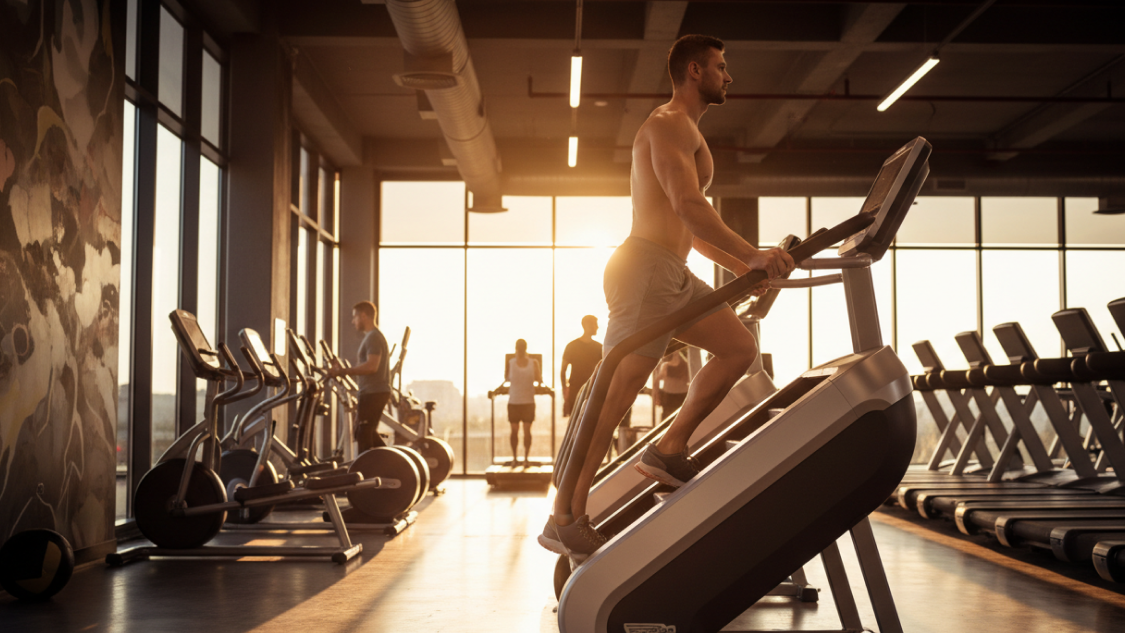
You get on the StairMaster and start climbing. Five minutes later, your legs are burning, you're breathing hard, and you’ve started pulling on the handrails just to keep going. You might even wonder, “Am I going too fast, or am I just not fit enough?”
For beginners, it's easy to get the basics wrong. The right technique protects your joints and helps you reach your fitness goals. In this article, you'll learn how to use a StairMaster correctly. So, keep reading.
1. What Does a StairMaster Workout Do?
A StairMaster workout is primarily a cardio exercise. Because you are repeatedly lifting your body upward against resistance, your heart rate rises. So if you increase the speed or resistance for short bursts, your heart rate can move into a higher-intensity zone, adding an anaerobic element to the workout.
What Muscles Does the StairMaster Work?
Correct use of this machine activates your glutes, quadriceps, and hamstring muscles, which means it mainly engages your lower body with meaningful strength-endurance training. Your core also works to help you stay balanced and upright. Different stepping techniques engage different muscles you feel most. Taking controlled, deeper steps can make your glutes work harder, while shorter and faster steps tend to place more emphasis on your quads and calves. Correct use of this machine engages your glutes, quadriceps, and hamstrings.
How Many Calories Does a StairMaster Burn?
The calories burned on StairMaster depend mainly on your body weight, stepping speed, resistance, and workout duration. A heavier person or someone exercising at a higher intensity will generally burn more calories during the same 30-minute session.
As a general estimate, a 30-minute StairMaster workout can burn around 180–300 calories. A steady moderate session will typically fall toward the lower end, while faster or higher-resistance intervals can push calorie burn higher.
| Workout Intensity | 30-Min Calories Burned* | Main Focus |
|---|---|---|
| Low | ~150–200 kcal | Light cardio & endurance |
| Moderate | ~200–250 kcal | Aerobic fitness & calorie burn |
| Vigorous | ~250–300+ kcal | Higher-intensity cardio & leg endurance |
2. How to Use the StairMaster Correctly?
While StairMaster may look different from the one you have, they are all pretty similar at the end of the day, with all the same features that do the same thing. So this can definitely still be a helpful step-by-step guide for you to learn how to use a stair stepper machine, even if your StairMaster is not the same.
Step 1: Adjust the Machine Before You Start
Before you start your workout, make sure the machine is properly set up. On the StairMaster screen, you can see all the options you have—whether you want to do one of the StairMaster workouts, throw some Netflix on the screen, connect your headphones, and much more. You can also see how fast you're going, how many floors you've walked, and how long you've been working out.
Take a little look at the screen, and you will see a "start" button. Don't touch "resume", because you might be resuming the last person's workout. Many people get on, think they've pressed start, and actually they've resumed the last person's workout. So make sure it says "start" before you get onto the machine.
Right underneath the screen, you have a place to set your phone, wallet, keys, and whatever else you need to store, as well as a spot for your water bottle. To start the workout, make sure to:
- Check that the machine pedals move smoothly
- Wear supportive training shoes
- Keep a water bottle and towel nearby
If you enjoy the challenge of climbing stairs but don't want to spend extra time going to the gym, a compact home stair stepper can be a practical alternative. It takes up much less space than a commercial StairMaster while still giving a challenging climbing-style workout.
Due to its vertical climbing motion, your glutes, quadriceps, hamstrings, and calf muscles engage. Its adjustable resistance enables you to match different fitness levels. With a foldable design, this machine stores easily. You can store it in apartments or home gyms.

Step 2: Place Your Feet Correctly
Make sure your whole foot is on the pedal to activate glutes, quadriceps, hamstrings, and calf muscles. This increases the risk of soreness and overuse injuries. So, never let your heel hang off the pedals. Otherwise, it increases slippage and disrupts body balance.
When you click "start," make sure that you're on the second step or the top step. You don't want to be on the bottom step, because once you press start, this bottom step is going to disappear, and you don't want to slip off the machine. It will always begin at a pretty slow pace, so there's no need to worry that it'll go too fast right off the bat.
Step 3: Maintain Proper Posture
We're looking to be nice and upright. Some beginners lean forward during workouts. It reduces balance and shifts pressure away from the target muscles. To maintain good posture, follow this:
- Keep your core engaged and make sure your foot is completely straight when you're stepping.
- Make sure you're not stepping off to the side and get as much of the foot on as possible.
- Stay looking up or looking at the screen. Try not to come into a hunched posture, and try not to come too far down.
Step 4: Use the Handrails the Right Way
If you need a little bit of extra support, you can always hold on to any of these handlebars that you see here as well. They are for your heart rate. So when you're on the stepper, you can have both hands on the handles. You can have them a little bit lower down if you want to.
Once you feel comfortable and can maintain your balance, you can gradually reduce your grip or let go for short periods. And if you start to feel unsteady or tired, it's perfectly fine to hold the handrails again. The goal isn't to avoid them completely. For beginners, getting comfortable and maintaining good posture comes first; using less support can come naturally as your balance improves.
Tips for using the handrails:
- Try not to lean your body weight onto the handrails.
- Take a light grip for balance and let your legs and glutes do most of the work.
- Keep your elbows upright.
- If you feel a tight grip on the handrail, reduce your step speed.
Step 5: Adjust Speed & Intensity
To increase the speed, you can just press the plus sign next to "level" on the screen. Likewise, if you need to decrease the speed, just click the minus sign. Alternatively, you can avoid touching the touchscreen interface. At the top of the handrails are the plus and minus buttons, which make it harder or easier.
- Beginners: Start around level 1–3 for 5–10 minutes. Focus on finding a comfortable rhythm and getting used to the stepping motion.
- Intermediate users: Try levels 4–7 and maintain a steady pace for 15–30 minutes. You should feel your breathing increase.
- Advanced users: Use around level 8–12+ or add short high-intensity intervals. This can raise your heart rate and make the workout more demanding.
Step 6: Choose a Workout & Set Your Goal
Once you're comfortable with the basic stepping motion, you can use the StairMaster's built-in workout options to structure your session. Click "exercises," and you might decide you want to do a certain routine, like a glutes routine or a weight-focused routine. You can have a routine that's driven by your heart rate, and you can also do testing.
For example, if you click "exercise time and goal" or "exercise goal in time" and set it for 30 minutes, then at the end of the 30 minutes, what's going to happen is the machine is automatically going to go into a cool-down and then stop.
If your machine has a touchscreen, you can log in or connect via Bluetooth to save your workout history. On the main screen, you can go on the web, play games, go on Facebook, and change the language. Scroll the screen to watch TV, listen to the radio, look at the weather, go on YouTube, and do outdoor circuits as well.
Step 7: Cool Down & End Workout
If you need to pause the workout, click the "pause" button. You can then choose whether you want to do a cool-down or have a drink of water and then restart, and you won't lose any of your statistics.
When you're done and want to end the workout, you can press the large red button "stop" on the handle or on the screen, which will automatically stop the StairMaster. Then wait until the stairs stop completely. After the workout, follow the steps below to stretch:
- Stretch your calves: Place one foot behind the other and gently press the back heel toward the floor. Hold for 15–30 seconds on each side.
- Stretch your quadriceps: Stand tall, hold onto a stable surface if needed, and gently bring one heel toward your glutes. Keep your knees close together and hold for 15–30 seconds.
- Stretch your hamstrings: Place one leg slightly forward with the heel down and gently lean your hips back until you feel a light stretch along the back of your thigh.
- Stretch your glutes: Sit or stand in a comfortable position and bring one knee toward your chest. Hold the stretch gently before switching sides.
3. FAQs about Using StairMaster
Before stepping onto a StairMaster, you probably still have a few questions. How long should you use it? Can it really help with weight loss? And should I buy a StairMaster or a stair stepper for home use? Here are the answers to some of the most common questions before starting your workouts.
Q1: How long should you use a StairMaster?
Generally, the ideal workout duration depends on your training goal, endurance, and fitness level. As a complete beginner, you can spend 10–15 minutes per session. Furthermore, make sure to do the session 3–4 days per week. Always keep the session resistance low to moderate. Once you complete the session, increase duration gradually.
If you use the stair stepper beforehand, then do the exercise for 20–30 minutes. Ensure you take this session 4–5 days per week. At this stage, you can gradually increase the resistance. An advanced user can train the body for 30–45 minutes with a stair stepper. A 4–6-day session per week is ideal for them. However, it's still dependent on their fitness goals and recovery.
Q2: What is the difference between a StairMaster and a stair stepper?
Although the names are often used interchangeably, they are different machines. The main difference between a StairMaster vs stair stepper is the stepping motion and where you typically use them.
A StairMaster is more common in gyms, with continuously rotating steps that simulate walking up a real staircase. It often provides more advanced features, such as workout programs, heart-rate tracking, and higher resistance options. This makes it popular for challenging cardio workouts.
A stair stepper typically uses two independent pedals that move up and down. It creates a similar climbing motion but usually takes up less space and is more common for home workouts.
If you want a gym-style climbing experience, a StairMaster may be a better choice. If you need a space-saving machine for home training, a stair stepper is often more practical.
Q3: Is a StairMaster better than running for weight loss?
Both the StairMaster and running can support weight loss. In running, you burn more calories in less time. However, it also creates more impact on knees and ankles. The StairMaster provides a lower-impact cardio workout while strengthening your lower body.
If your goal is to burn the most calories in the shortest time, running may have an advantage. But if you want a low-impact workout that you can do consistently, the StairMaster can be an effective choice.
4. Conclusion
To sum up, using the StairMaster correctly makes your workout safer.Once your posture is balanced, increase the workout intensity as your fitness improves.
However, you need to follow tested tips to get better results. Always engage your legs and core to do the work and maximize muscle engagement. Right now, track your workout time and resistance level. These steps measure your progress and help you stay motivated. To achieve better results, combine stair-stepper workouts with strength training.