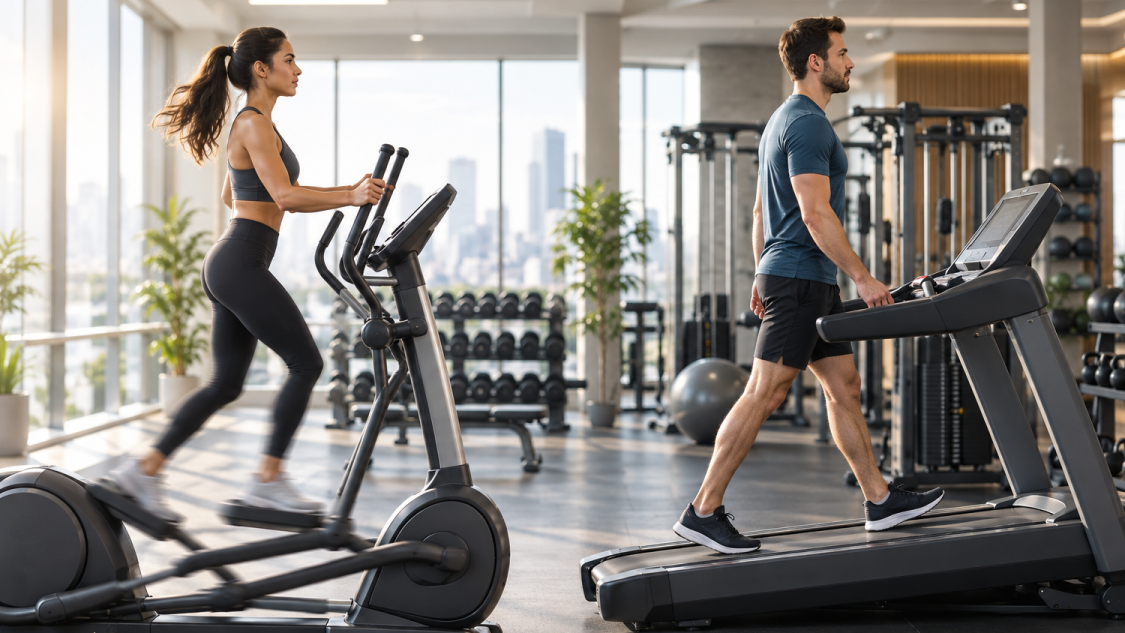
When you're trying to lose weight, you may have heard that running burns a lot of calories, while others recommend the StairMaster. But which one actually helps you burn more calories?
In this article, you will explore the key differences between StairMaster and running and useful tips to choose a better workout.
1. StairMaster vs. Running: What's the Difference?
StairMaster and running can both provide challenging cardio workouts, but they differ in movement, intensity, muscle involvement, and how much energy you use during a session. Before exploring their key difference, let's understand how the StairMaster or running works.
How Does the StairMaster Work?

A StairMaster is a cardio machine that uses continuously moving steps to simulate climbing stairs. Each step requires you to lift your body upward against gravity, so the glutes, quadriceps, hamstrings, and calves do much of the work. Your core also helps stabilize your posture as you step.
How Does Running Work?

Primarily, running is a high-impact cardiovascular exercise. During running, both feet leave the ground during each stride. This repeated movement engages the glutes, core, and stabilizing muscles. Naturally, this workout increases heart rate and energy expenditure. This is one of the most effective exercises for burning calories.
2. StairMaster vs. Running: A Detailed Comparison
Both workouts are excellent for cardiovascular health. They challenge your body in different ways. One workout mainly emphasizes lower body strength. On the other hand, the second exercise increases calorie burn. You need to understand the key factors that help you choose a workout.
Calories Burned
In a 30-minute StairMaster workout, you can burn 180–300 calories. It depends on your body weight, machine speed, and workout intensity. You can increase the speed and resistance to make the activity more challenging. It raises your heart rate and boosts calorie burn. Because the movement is continuous, the StairMaster is an effective cardio workout.
During running, you can burn 300–500 calories in 30 minutes. However, the exact number depends on your body weight and running pace. If you run on a hill at a faster speed, it increases calorie expenditure. A 10-minute-per-mile pace of intensive running generally burns more calories. Therefore, it is one of the most efficient cardio exercises for weight loss.
Lower-Body Strength and Glute Development
If your goal is to build strong leg muscles, the StairMaster is made for that. With every step on the StairMaster, your glutes, quadriceps, hamstrings, and calves work against gravity. The muscles are under constant tension throughout the workout. In this way, it helps improve muscular endurance. You can also experience strengthening of the lower body. Throughout the workout, the glutes remain actively engaged during every step.
During running, your lower body parts are mainly active. It triggers the glutes, quadriceps, hamstrings, calves, and hip flexors. However, the muscles contract and relax more quickly. So, it develops explosive power, coordination, and functional strength. However, it does not maintain the same continuous muscular tension.
Overall, the StairMaster or running contributes to glute-focused endurance training.
Muscle Activation
Both stair stepper vs running workouts activate muscle groups in different patterns.
During every stroke of the StairMaster, your glutes, quadriceps, hamstrings, and calves activate. It requires your lower body to lift your body weight upward. So, your core stabilizes your posture and balance. The repetitive motion creates muscle engagement. Due to collective muscle engagement, this workout improves lower-body endurance. You can strengthen muscles used in everyday activities.
While running, your core muscles work together to propel your body forward. It includes the quadriceps, hamstrings, calves, and hip flexors. Your arms and shoulders move to maintain balance. It creates body rhythm throughout each stride. Because running requires coordinated movement, it develops athletic performance. You can develop lower-body power in addition to cardiovascular fitness.
Cardiovascular Benefits
The StairMaster session is designed to keep your heart rate in a vigorous training zone. This is effective for improving cardiovascular endurance. You can improve aerobic endurance and circulation. Through a workout, your body remains steady and controlled. So, you can maintain your target heart rate without excessive fatigue.
On the other hand, running on the treadmill places greater demand on the cardiovascular system. This machine improves VO₂ max and strengthens the heart. Furthermore, it reaches higher heart-rate zones more quickly.
Workout Intensity
The StairMaster workout enables you to adjust the stepping speed and resistance. You can match both these indicators to your needs. Your heart rate should be between 60% and 80% of your maximum rate during this workout. It's ideal for endurance training.
On the flip side, running provides a much broader intensity range. Generally, comfortable running supports aerobic endurance. However, running faster on a hill surface can raise your heart rate. Its range is between 80% and 95% of your maximum heart rate. This versatility makes running an excellent option for endurance athletes.
3. StairMaster vs. Running: Which Workout Should You Choose?
The selection of a better StairMaster or running workout totally influences your fitness journey. So, you have to evaluate your fitness goal and personal preference. Here are criteria that help you make a valid decision.
The StairMaster workout is made for you if you:
- Want a low-impact workout that reduces ankle stress.
- Build stronger glutes, quads, and hamstrings.
- Look forward to a steady-state cardio workout.
- Reduce joint discomfort.
- Prefer mainly indoor workouts.
Running is an ideal choice if you:
- Burn more calories.
- Improve cardiovascular endurance.
- Enjoy outdoor workouts.
- Workout with minimal equipment.
- Handle higher impact on your joints.
4. What Should You Avoid During StairMaster and Running Workouts?
Remember, both exercises make a significant impact on your body. So, you need to take some precautions. So, each session progresses toward your fitness instead of injuries.
Avoid Increasing Intensity Too Quickly
This is one of the biggest mistakes beginners make. They start sessions at high intensity. After a few weeks, these workouts lead to fatigue and poor form. Always be sure to begin with a slow speed and provide your body time to adapt to it. Then, increase your workout gradually. It is best to add a few minutes of rest to your session. This steadily reduces the risk of overuse injuries.
Incorrect Footwear
Make sure to invest in quality shoes. Unsupportive shoes lead to discomfort. Furthermore, some shoes' soles cause stability issues during workouts. Always choose well-cushioned footwear. It is best to match your foot type and replace them regularly to maintain proper support.
Avoid Skipping Recovery & Warm-Up
Since the beginning of the session, you have been fully motivated. So, you never take a break or rest. It is not a healthy practice. Always take a break to recover and properly warm up your body. You have to spend 5 to 10 minutes walking before starting the session.
This increases blood flow and makes your body fully prepared for exercise. During the whole period, hydrate your body. Take a water bottle and drink water after a few strokes. Your sleeping cycle matters a lot. Make sure to get adequate sleep.
5. FAQs about Stair Master & Running
Still deciding between the StairMaster and running? These questions cover some of the most common concerns when choosing between the two.
Q1: Can You Combine StairMaster and Running?
Yes, you can combine the StairMaster and running. This combination can improve cardiovascular fitness and reduce injuries. You can use running to increase calorie burn and improve speed. However, you can add a StairMaster to strengthen your legs with less joint impact. This provides workout variety and helps you develop both aerobic fitness and endurance.
Q2: Which is harder, StairMaster or running?
Definitely, running is generally harder. It places greater demands on your cardiovascular system. Furthermore, it puts stress on knees and joints. A StairMaster is challenging too, but it's a lower-impact exercise.
Q3: Which is better for beginners, StairMaster or running?
Either can work for beginners when the intensity is appropriate. A StairMaster may be easier to control if you prefer a steady stepping pattern, while running requires you to adapt to repeated impact and running mechanics. Start with short sessions and increase duration or intensity gradually.
6. Conclusion
To sum up, StairMaster vs running: which is ideal for losing weight in less time? Well, running is best for achieving the goal. However, always consider fitness goals, budget, and physical condition before making any decision.