


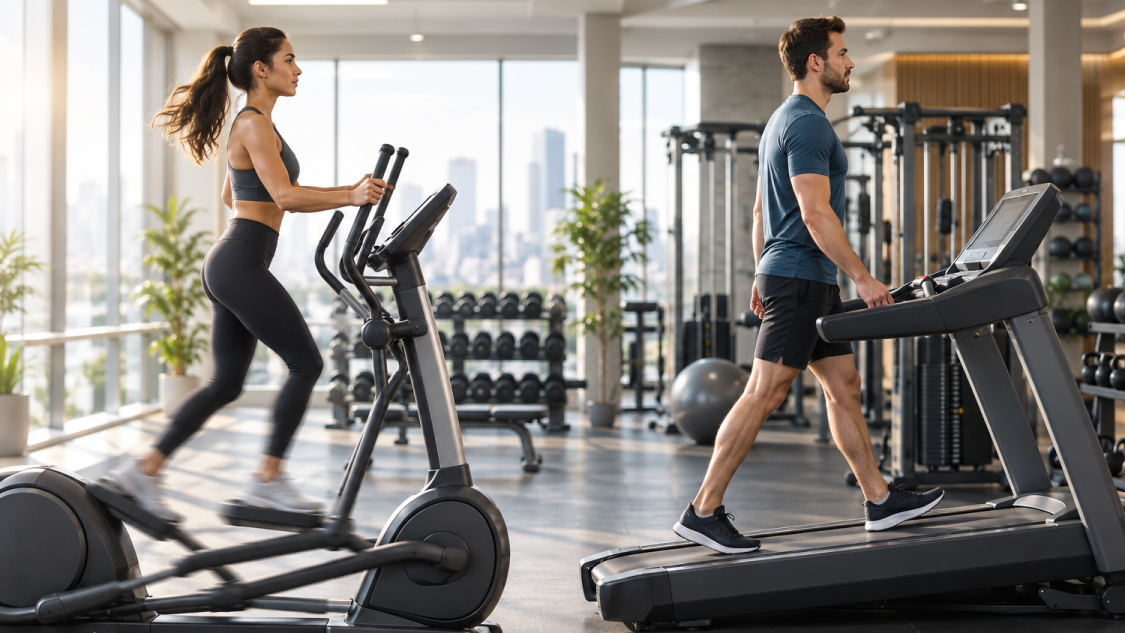
Have you recently decided to focus on your fitness and lose weight without stressing your joints? If you want a low-impact way to increase your cardio without relying on running, both the elliptical and incline walking are worth considering.
So, which one fits your fitness goal better? In this article, you will explore the key differences between elliptical vs incline walking. A short section of key tips and factors that help you choose the right workout for your goals.
1. What’s the Difference Between Elliptical & Incline Walking?
Primarily, the elliptical is a cardio machine where you stand on two pedals and move your legs. Throughout exercise, your feet stay on the pedals. Most machines also have moving handles. Therefore, you can work your arms along with your legs. This makes the elliptical useful for raising your heart rate.
Its core principle is continuous movement against resistance. At every step, your legs push the pedals forward. Furthermore, your arms move with the handles. From the start, always take a slow step and gradually increase the resistance or speed.
Fundamentally, this is a treadmill workout where you walk. During the session, the belt is raised at an angle and maintains the natural walking motion. However, the incline makes your body work harder to move upward. It is simple to perform, and you can easily set the workout duration.
Its core principle is moving your body upward against gravity. As the incline increases, your lower-body muscles have to produce more force with each step. Generally, incline walking increases the metabolic cost by about 52% to 5%.
2. Elliptical vs. Incline Walking for Weight Loss
Both elliptical and incline walking increase the amount of energy expenditure and support weight loss. However, they create that demand in different ways. Here are key differences between incline walking vs elliptical exercises that enable you to evaluate.
Caloric Burn Rate

During an elliptical workout, the body creates a higher calorie demand when you increase the resistance. A 70 kg person can burn 175 calories in 30 minutes with a moderate workout. However, the vigorous effort can reach around 315 calories in 30 minutes. The exact number depends on your body weight and how hard you exercise. When the resistance increases, the stride rate raises oxygen use. So, your body perceives effort during elliptical training.

On the other hand, incline walking can also increase calorie burn without running. The steeper the incline, the more energy your body needs to move upward. A 5% incline can substantially increase the metabolic cost of walking compared with level walking. A 70-kg person walking can burn roughly 121 calories on a flat treadmill. The calorie burn will be 197 calories at a 5% incline. In short, adding an incline can make walking much more demanding.
Here is a table comparison of calorie burn in incline walking vs elliptical.
| 30-Minute Session | Elliptical | Incline Walking |
|---|---|---|
| Moderate effort / lower incline | 175 calories | 121–197 calories |
| Higher intensity / steeper incline | 315 calories | 273 calories at 10% incline |
Workout Intensity
In elliptical exercise, you have several ways to control intensity. You can increase resistance and increase your stride rate. Another great way is to actively push and pull the handles. When you tested different resistance levels and stride rates, you increased oxygen consumption and heart rate. This means you can start at a comfortable pace. So, you may gradually make the workout harder as your fitness improves.
On the flip side, incline walking mainly becomes more challenging as treadmill speed increases. Without majorly changing your speed, raising the incline can significantly increase the workout intensity. Generally, a 5% incline increased metabolic cost by about 52%. Furthermore, a 10% incline increased it by about 113%. This makes incline walking a simple way to increase intensity.
3. Target Muscle Groups
For muscle engagement, the elliptical can involve both your upper and lower body. It includes the quadriceps, hamstrings, glutes, and calf muscles. Additionally, your arms and upper body contribute through the handles. This makes the cardio session involve more muscle groups.
In contrast, incline walking activates your lower body. During this session, every step requires you to move upward against gravity. So, the calf, quadriceps, hamstring, and glute muscles contribute to this movement. Mainly, the activity in the soleus and vastus lateralis increases the metabolic cost of incline walking.
Here is a table that provides insight into target muscles in incline walking vs elliptical for fat loss.
| Muscle Engagement | Elliptical | Incline Walking |
|---|---|---|
| Main muscles | Quads, glutes, hamstrings | Glutes, quads, calves, hamstrings |
| Main advantage | More continuous lower-body engagement | Greater lower-body demand as incline rises |
4. Elliptical vs. Incline Walking: Which One Should You Choose?
Here are details about each incline walk vs elliptical workout based on your overall fitness goal. This helps you choose a workout without any further confusion.
For Higher Calorie Burn in Less Time
If you just start working out to burn calories, then choose the elliptical. This workout is best for people who have limited time and want demanding exercise. You can increase the resistance by moving the handles. However, a higher calorie burn does not automatically mean faster weight loss. You still need to combine it with a balanced diet and other exercise.
For Lower-Body Focus
If you prefer walking but want an easier way to increase the intensity of your workouts, the MERACH W60 combines an under-desk-friendly design with 12 levels of automatic incline. You can use it for light walking while working or during everyday activities, then raise the incline when you want a more challenging cardio session.
For Joint-Friendly Cardio
To maintain joint and cardio health, both elliptical vs walking on incline exercises work well. During an elliptical workout, your feet stay on the pedals. So, there is no repeated foot strike against the ground. Its smooth motion can make the elliptical a comfortable option for people who prefer lower-impact cardio. Furthermore, incline walking also keeps you in a walking pattern. You can increase the incline to change muscle activation demand. If you have joint discomfort, make sure to begin with a mild incline.
For a Workout You Can Maintain
Some people start a workout and face challenges to continue further. If consistency is your real issue, then choose the workout that is easily adaptable. Generally, you can complete 30 minutes on the elliptical 3–4 times a week. After this session, you don't feel overly fatigued. It also provides a useful training volume. You can gradually increase the duration as your fitness improves. If walking is more comfortable, then choose incline walking. This can also be easier to maintain.
For the Best Long-Term Approach

There is an option to combine the elliptical and incline walking. Well, it can give your routine more variety. If you want to start indoor walking, the Merach W60 Under-Desk Walking Pad works well. It has a 12-level auto incline that gives you a simple way to increase workout intensity when flat walking starts to feel too easy. The 33% wider deck also gives you more walking room without taking away from its storage-friendly design. At any point, you can also adjust the duration and intensity based on how your body feels. The main goal is to choose a workout that supports your goal.
5. FAQs about Elliptical vs. Incline Walking
Still deciding between an elliptical and incline walking? These questions address the practical differences that can help you choose the right workout for your routine.
Q1: Should beginners start with an elliptical or incline walking?
Either can work for beginners. Walking may feel more familiar and make it easy to control your pace and duration, while the elliptical provides a smooth movement with adjustable resistance. Start with a comfortable intensity on either machine and increase the duration or resistance gradually as your fitness improves.
Q2: What incline should beginners use for incline walking?
There is no single incline that works for everyone. Start with a low incline that allows you to maintain a natural walking posture and steady pace. Once that feels manageable, increase the incline gradually rather than jumping straight to a steep setting.
Q3: Can I do elliptical and incline walking in the same week?
Yes. Combining them can add variety without requiring you to rely on one type of movement for every workout. For example, you could use the elliptical for resistance-based cardio on one day and incline walking for a walking-focused session on another day. Adjust the intensity and duration based on your fitness level and recovery.
6. Conclusion
To sum up, elliptical vs incline walking: which is better? No doubt, both workouts support different fitness levels and can be done comfortably. If you choose the elliptical, do not start with high resistance. Additionally, never take a fast pace before your body is ready. Always avoid pulling heavily on the handles. Never use high momentum to complete the movement.
With incline walking, avoid starting with a very steep incline. Make sure to never hold the handrails to support your body weight. This can change your natural walking pattern. In addition, it also reduces the work your body has to perform.
If you feel joint pain, dizziness, or unusual shortness of breath, stop the exercise immediately. Furthermore, never ignore excessive fatigue during either workout. Make sure to do research before increasing your workout duration, resistance, or incline. Always track your sessions in incline walking vs elliptical and focus on steady progress.


