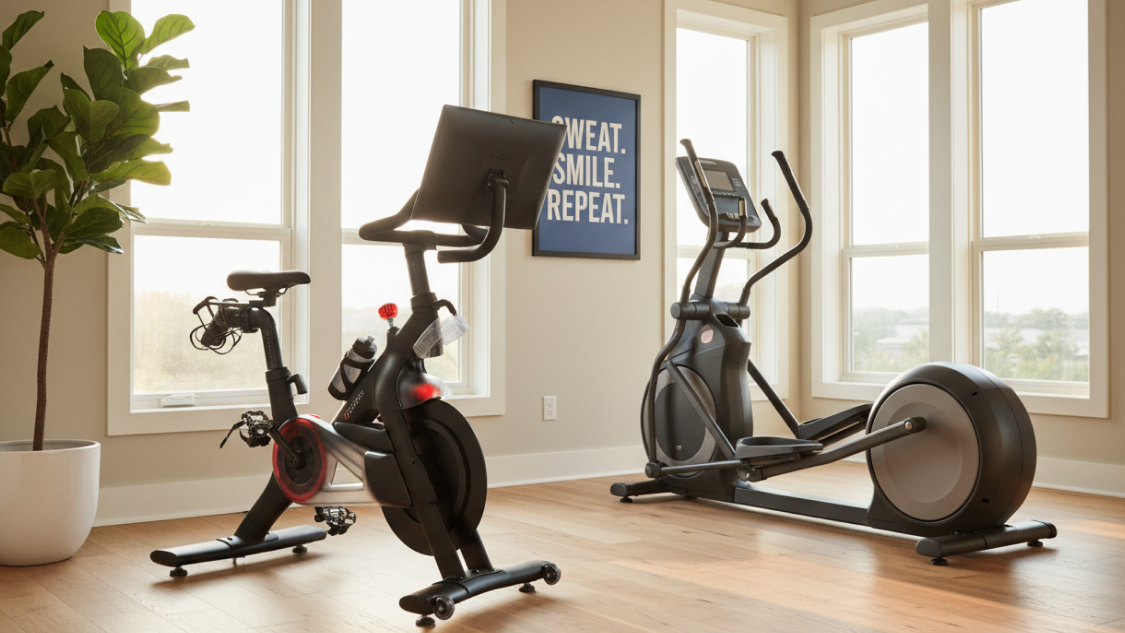
More and more individuals are working out at home. They buy basic, adequate cardio equipment to stay fit without leaving home. Among the top choices, the exercise bike vs. elliptical debate continues to stand out as both machines offer low-impact, calorie-burning workouts suitable for all fitness levels. It’s not as easy to pick between exercise bikes and ellipticals because both promise to torch calories and transform your body—but which one actually delivers?
This blog explains the main distinctions, advantages, and uses of each machine so you may choose the one that will help you reach your fitness objectives with confidence.
1. Exercise Bike vs. Elliptical: Quick Review
For a clear, quick overview of how these two popular home fitness machines compare, here’s a breakdown of their overview, main types, and who they’re best for—helping you quickly understand the key differences.
Exercise Bike: Overview, Types & Best For
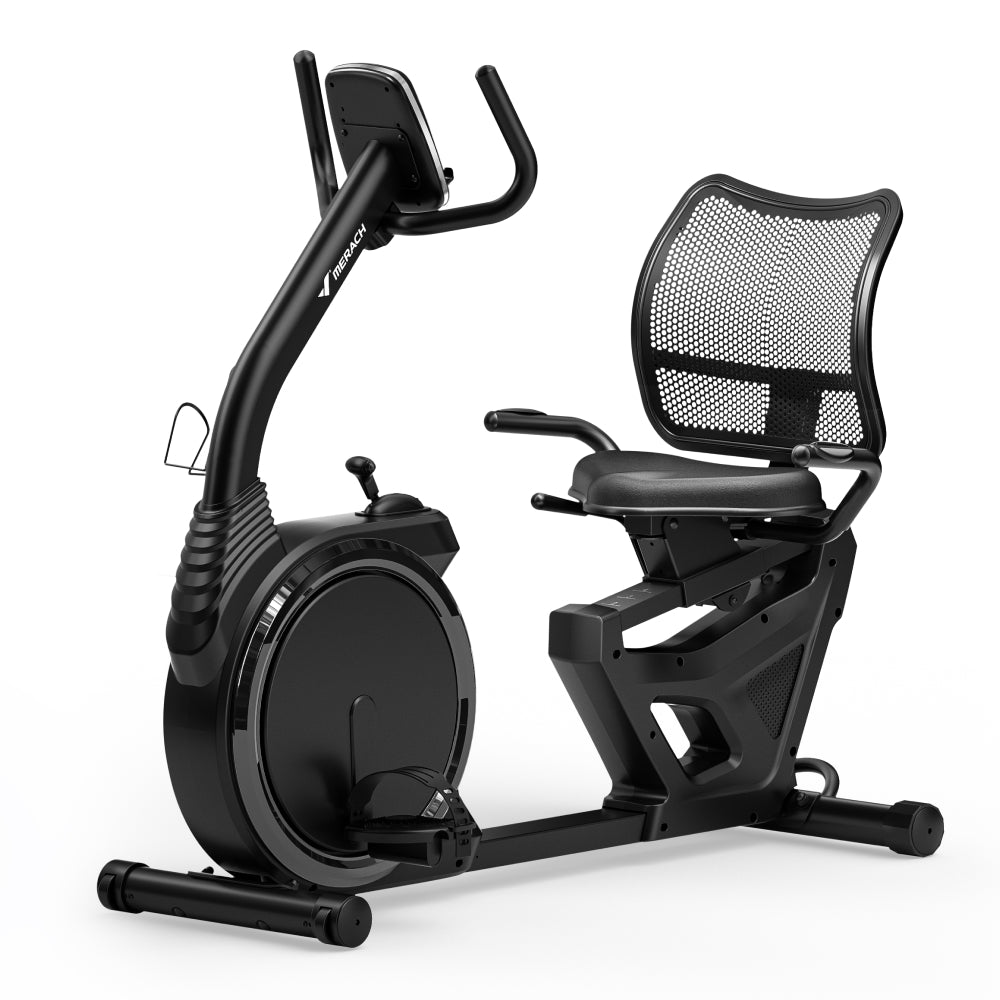
There are three fundamental styles of exercise bikes: upright, recumbent, and spin. Upright bikes look like regular bikes and make you ride in a way that strengthens your core and lower body. Recumbent bikes are more comfortable and supportive since they have bigger seats and backrests. People with back pain or who just want to sit back and relax will love these. On the other hand, spin bikes are designed for high-intensity workouts, with heavier flywheels and greater resistance, often used for interval training and calorie-focused rides.
Exercise bikes are best for beginners, people recovering from injury, those with knee or back concerns, and anyone looking for a compact, easy-to-use cardio machine for home workouts. They’re also a solid choice for users who prefer seated workouts or have limited space.

Elliptical Machine: Overview, Types & Best For
An elliptical machine, also known as a cross-trainer, simulates walking, running, and stair-climbing motions while minimizing impact on joints. There are three main types of ellipticals: rear-drive, where the flywheel is at the back; front-drive, where the flywheel is at the front; and center-drive, where the flywheel is in the middle for a more natural stride.
It provides a full-body workout by engaging both upper and lower body muscles simultaneously to improve cardiovascular fitness, burn more calories, and have greater overall stamina. People with joint issues, arthritis, or those recovering from injuries like ellipticals because they offer a good workout that is easy on your joints and works out multiple muscle groups at once.

Exercise Bike vs. Elliptical: Key Differences
Between the exercise bike vs. elliptical, the main differences lie in movement patterns and workout style.
People remain seated on the exercise bike and cycle in circles. It primarily works the lower body, especially the quads, hamstrings, and calves. Exercise bikes are ideal for building endurance and those who prefer a more controlled, seated workout.
Ellipticals, on the other hand, make you stand and move in a natural, gliding fashion, working both your upper and lower body by engaging your arms and legs simultaneously. It is a full-body workout that engages more muscle groups, providing a higher-intensity cardio session. Many fitness lovers use an exercise bike and an elliptical trainer together to improve their strength, endurance, and overall fitness.
2. Exercise Bike vs Elliptical: Calorie Burn for Weight Loss
One crucial factor to consider in the exercise bike vs. elliptical comparison is the difference in calorie burn. Both machines are suitable for cardio, but the elliptical burns more calories because it works both the upper and lower body. Below is a comparison of estimated calorie burn for an average 70–84 kg adult exercising for 30 minutes.
| Machine | Intensity | Calories burned (30 min) | Notes |
|---|---|---|---|
| Exercise bike | Light | 180–260 kcal | Steady pace, low resistance |
| Moderate | 260–390 kcal | Consistent cadence, moderate resistance | |
| High / HIIT | 390–550 kcal | Sprints or high resistance intervals | |
| Elliptical | Light | 240–320 kcal | Easy pace, low resistance |
| Moderate | 320–450 kcal | Full-body engagement | |
| High | 450–650+ kcal | High resistance or incline |
What Affects Calorie Burn on an Exercise Bike or Elliptical?
However, the machine isn’t the only factor. The number of calories you actually burn depends on how hard you work out, how fast you go, and how much resistance you use.
- Resistance settings: Although the elliptical burns more calories per minute due to full-body involvement, exercise bikes can still burn comparable calories at higher resistance or cadence.
- Workout style: HIIT on either machine burns more calories than steady-state cardio. A bike sprint session can easily match or exceed an elliptical workout.
- Weight & Fitness level: Heavier users and beginners typically burn more calories initially, while fitter users may need higher intensity to achieve the same burn.
Ellipticals are great for people who want to burn more calories and work more muscles in a single workout. Exercise bikes are great for lower-body-focused activities and are easy to operate. An exercise bike is the best way to work out your legs. If you want to do full-body cardio, get an elliptical.
3. Exercise Bike vs Elliptical: Muscle Toning & Strength
When focusing on muscle toning and strength, your choice between exercise bikes and elliptical trainers comes down to which muscle group you want to train.
The exercise bike is especially effective for lower-body toning, including the quadriceps, hamstrings, glutes, and calves. Some versions let you move your arms, but the primary focus is still on your legs, so they aren’t as helpful in working out your upper body. It is a strong choice for slimming legs, lifting glutes, or building lower-body stamina.

However, not all exercise bikes are limited to leg training. The Merach S26 Aura Exercise Bike with Screen bridges that gap. The pivoting display makes it easier to follow guided rides, standing intervals, or off-bike strength sessions that naturally bring the upper body into the workout. For users who want full-body results without feeling stuck in a repetitive routine, the S26 Aura offers a more engaging and versatile way to train at home.
In contrast, the elliptical offers a more comprehensive workout that incorporates both the upper and lower body. When users move the handles, they work their legs, especially their quads, hamstrings, and glutes, as well as their arms, shoulders, and back. The overall muscle stimulus is more evenly distributed but generally less intense for any single muscle group.
4. Joint Impact & Senior-Friendly Cardio Options
Both of these exercises are low-impact, so they're ideal for recovery and seniors. However, not all models are suitable, and their functions are also different.

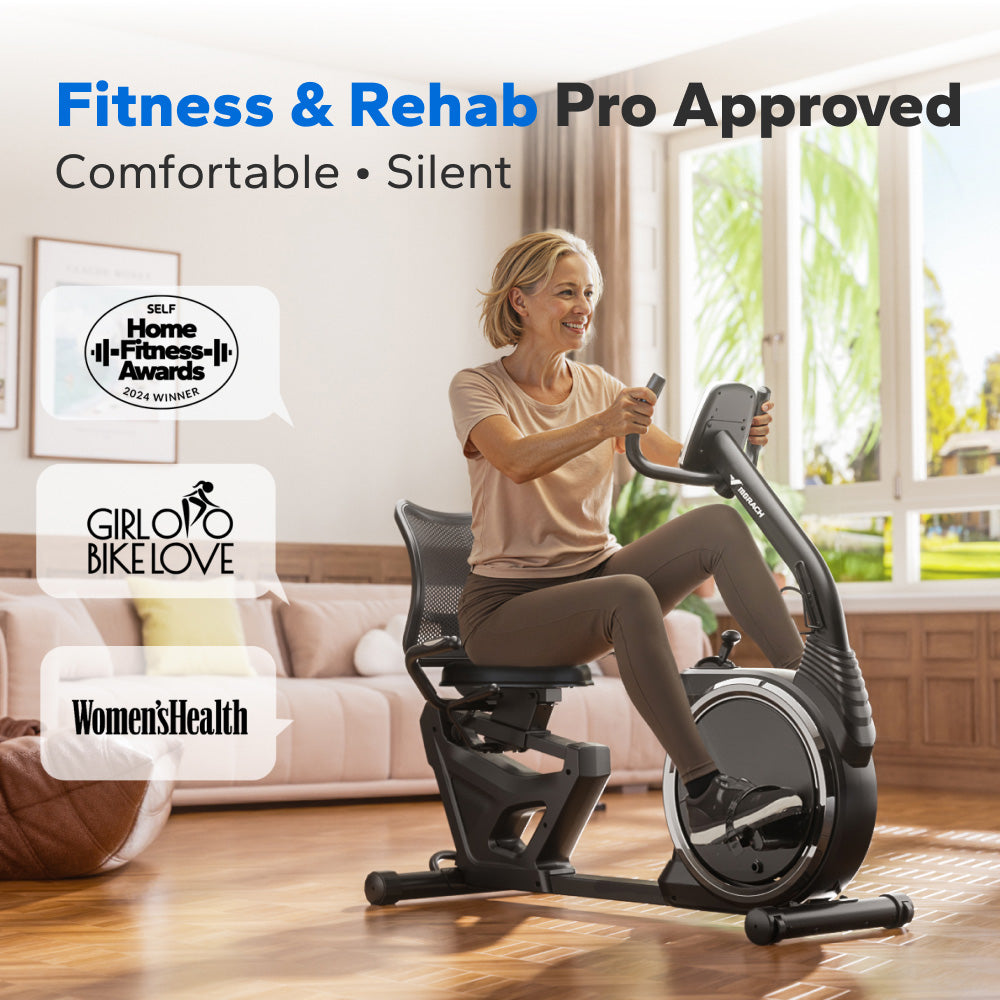
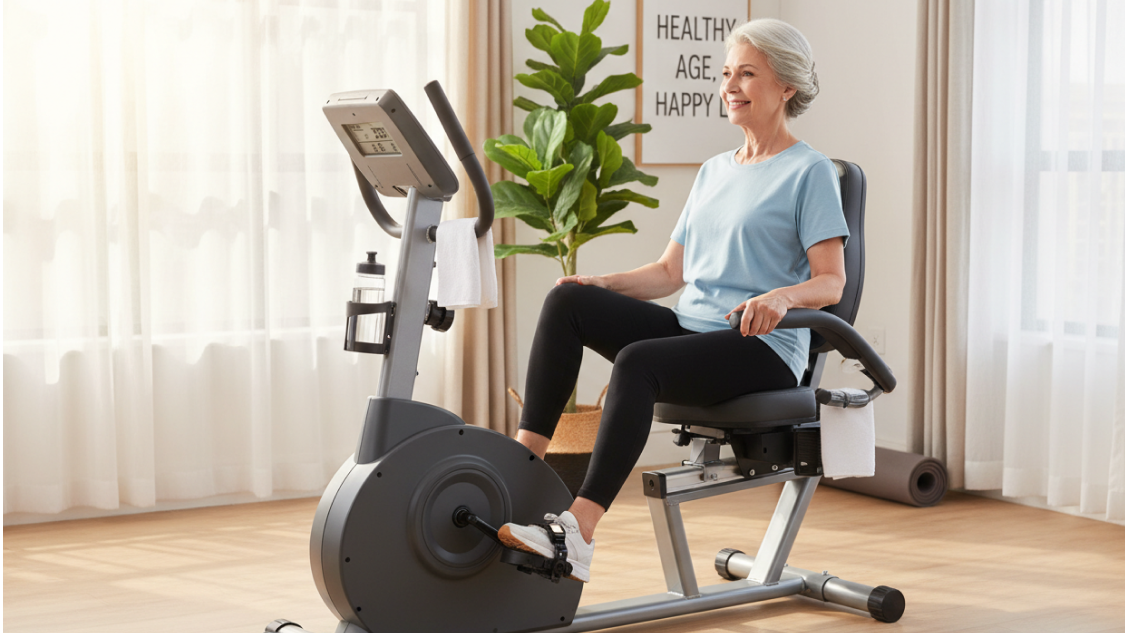
The way you sit on the exercise bike makes it easier on your knees, hips, and ankles. It is a great feature for older folks or people recovering from an illness. Bikes are generally easier to use, with a lower learning curve than ellipticals. Many models feature adjustable seats, backrests, and handlebars to accommodate different body types and comfort needs. Especially the recumbent bike, it offers more support and comfort for seniors, making it easier for them to maintain proper posture while working out.

Since ellipticals require standing, they provide some bone-strengthening benefits that seated bikes don't offer. This can be beneficial for maintaining bone density and improving overall muscle tone. However, an upright elliptical trainer requires more balance and coordination compared to an exercise bike. Therefore, for seniors with poor balance, a mini under-desk elliptical is recommended. Because it’s used while seated, it removes balance concerns entirely. The Merach mini under-desk elliptical offers resistance bands to work the upper body, and remote control operation allows seniors to adjust speed or modes without bending down, protecting the waist and lower back.
5. Home Use: Space, Noise & Maintenance
When evaluating the Exercise Bike vs Elliptical, it’s essential to consider the space requirements, noise, and maintenance.
Exercise bikes are small, lightweight, and often compact, making them ideal for homes, apartments, or other spaces with limited space. Especially the magnetic exercise bike runs quietly and requires very little maintenance. Adjustable seats and handlebars also make them practical for households with multiple users.
Ellipticals, on the other hand, are bigger and take up more floor space because they are longer and taller. It is because gliding and full-body movement require space to work safely. For this reason, standard ellipticals are often better suited to users who have a dedicated workout area and feel comfortable standing while exercising. With more moving parts, they may need occasional lubrication and hardware checks over time. That said, not all ellipticals share these limitations. Compact options like mini under-desk elliptical machines significantly reduce space requirements. Their compact motors and simplified motion systems typically operate at very low noise levels. You can put it under a desk in apartments, living rooms, or even home offices.
6. Who Should Choose Which?
| Feature | Exercise bike | Elliptical |
|---|---|---|
| Calories burned | Moderate | High |
| Muscles worked | Legs, core | Full body |
| Joint impact | Very low | Low |
| Space needed | Small | Medium / large |
| Cost | Usually cheaper | Usually more expensive |
| Ease for beginners | Easy | Moderate |
Best for exercise bikes:
- People who are new to it
- People who are in rehab
- People who want to lose weight
Best for ellipticals:
- Workouts for the whole body
- People who want to work out more than one muscle group
- People who wish to do aerobic exercises that don’t hurt their joints
Ultimately, the exercise bike vs elliptical debate is influenced by personal preferences and fitness goals. It all comes down to what you want to achieve: if you’re going to work out your legs with little impact, get an exercise bike; if you’re going to do full-body cardio at a higher intensity, get an elliptical. Again, exercise bike vs ellipticals, when deciding between these, consider your fitness priorities carefully.
7. FAQ about Exercise Bike vs. Elliptical
Still unsure which machine fits your lifestyle, goals, or physical needs? You're not alone. Here, we answer the most commonly asked questions about exercise bikes and ellipticals.
Q1: Is an elliptical better than an exercise bike for overall fitness, and is there an exercise bike that works the whole body?
Ellipticals are often considered better for overall fitness because they engage both the upper and lower body at the same time. This full-body movement can improve cardiovascular endurance and coordination while increasing calorie burn per session.
Upright and spin bikes can activate the core through posture and standing intervals, and some exercise bikes are equipped with resistance bands or moving handlebars for light upper-body engagement.
Q2: Is an elliptical or a bike better for knee rehabilitation or joint stiffness?
For knee rehabilitation and joint stiffness, exercise bikes are usually safer and more comfortable. The seated position reduces joint loading and allows smooth, controlled range-of-motion work, which helps improve knee mobility and circulation without excessive strain.
Ellipticals can be beneficial later in rehabilitation when joint stability and coordination improve. In short, bikes tend to be better for early-stage rehab and stiffness relief, while ellipticals are more suitable once the knees can tolerate sustained standing motion.
Q3: How long should older adults use exercise bikes or ellipticals each day?
For older adults, shorter and more frequent sessions are usually more effective than long, intense workouts. Most seniors benefit from 10–20 minutes per session, once or twice a day, depending on comfort and fitness level.
8. Conclusion
After comparing every aspect, from calorie burn and joint impact to muscle engagement and home suitability, one truth remains clear: the best cardio machine is the one that matches your personal preferences and long-term fitness goals. If you want to work out your legs, an exercise bike is often the smarter investment. It’s easier to use, quieter, and ideal for daily cardio. If your goal is full-body conditioning and higher calorie burn, an elliptical is a great option. Think about what you want to achieve, choose the right machine for you, and start your fitness journey now to become a healthier, stronger you.