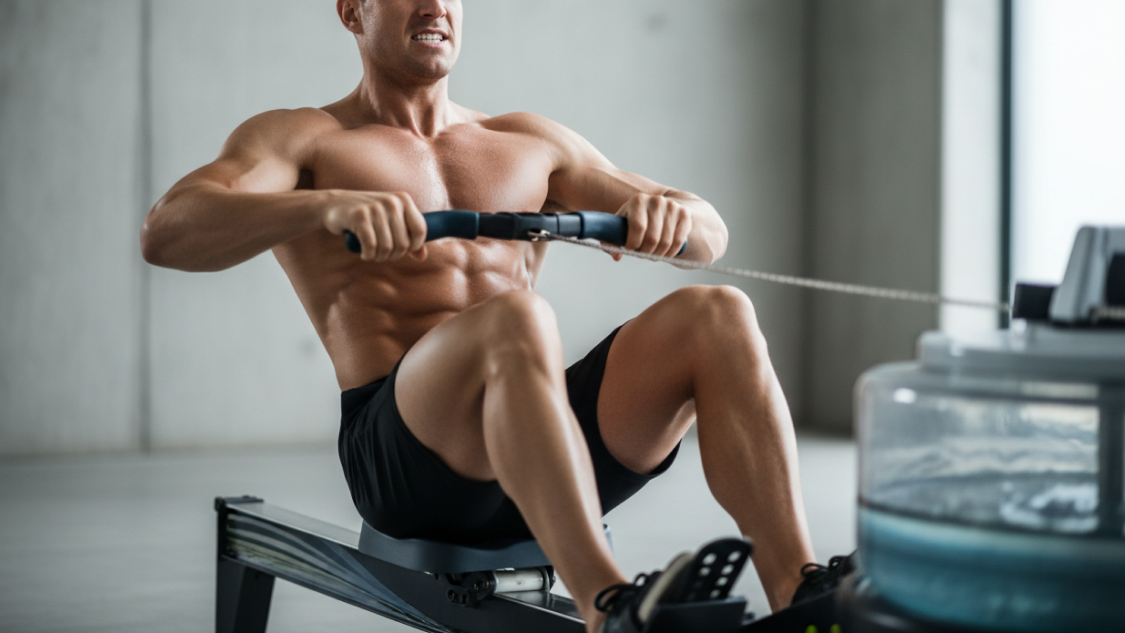
A rowing machine is usually considered the best exercise for full-body cardio. When you sit down on the rower, your arms, legs, and back will all be exercised. In reality, its versatility and professionalism go beyond that. This low-impact full-body workout is equally beneficial for the abdomen. But how do you feel your core working instead of just moving the handle back and forth? The key is to perform with the proper technique.
This article has been compiled to provide a structured, step-by-step guide for how to use a rowing machine for abs training effectively, along with the exact technique, breathing patterns, and even specific rowing machine workouts that intentionally engage, challenge, and strengthen your entire abdomen.
1. Which Core Muscle Does Rowing Engage?
A rowing machine engages a wide range of muscle groups, but the core plays a key role with every stroke. When you row with correct technique, your rectus abdominis, transverse abdominis, and obliques work in coordination to transfer force from your legs to your upper body and to stabilize your spine and pelvis during the rowing stroke.
- During the catch, your abdominal muscles help your spine and prep your body for generating force from your legs.
- When you pull, you'll tighten your abs.
- At the finish, your abdominal muscles work to stabilize and maintain a balance.
- And your core will be engaged throughout your recovery, ensuring that your rowing motion stays under control and prevents momentum from taking over.
If you have ever felt your lower back getting tired before your abs during workouts, it is usually because the core is not properly engaged.
2. Rowing vs. Crunches: Which Is Better?
Because your core stays active throughout the entire rowing cycle, rowing is a functional abs workout. That is why rowing is often more effective for building practical core strength than traditional floor-based ab exercises.
While crunches directly target the rectus abdominis, they are essentially an isolated, repetitive, and static contraction. Rowing, on the other hand, elevates core training to a completely different level: it's dynamic, functional, and seamlessly integrated into a powerful full-body metabolic workout.
Key Comparison: Rowing Machine vs. Crunches
| Feature | Rowing machine | Crunches |
|---|---|---|
| Core training | Dynamic core stability: Engages the entire core (including transverse abdominis, obliques, and back muscles) throughout the stroke to stabilize the torso and transfer power from legs to arms. This builds real-world, functional strength and anti-rotational stability. | Static ab isolation: Primarily isolates the superficial rectus abdominis through concentric (curl-up) and eccentric (lowering) contraction, with minimal engagement of deep stabilizers or coordination. |
| Calorie burn | High: As a high-intensity full-body cardio workout, 30 minutes can burn 250–400+ calories, significantly aiding fat loss and helping define abdominal muscles. | Low: An anaerobic strength exercise that mainly burns glycogen, contributing little to overall fat reduction. |
| Muscles worked | Full-body integration: Works legs (drive), back (pull), arms (finish), shoulders, and core (stabilization) in one fluid motion. One exercise, multiple major muscle groups. | Localized isolation: Focuses almost entirely on abdominal muscles, especially the upper abs. Offers limited benefits for overall strength or endurance. |
| Joint impact | Low-impact: Seated, smooth sliding motion places minimal stress on the spine, neck, and hips, making it safe and sustainable for most people with low injury risk. | Potential risk: Repetitive spinal flexion can strain the lower back (especially with poor form) and neck, and is not advised for those with existing issues. |
| Functionality | High: Directly improves cardiovascular health, muscular endurance, and dynamic stability, enhancing performance in daily activities and sports. | Low: Mainly improves muscle appearance and local muscular endurance, with limited carryover to functional movements. |
| Engagement & sustainability | Higher: Rhythmic, challenging, and data-driven (distance, time, stroke rate), making it easier to stay motivated and avoid monotony. | Lower: Repetitive and monotonous, often leading to boredom and difficulty maintaining long-term consistency. |
Choose crunches if your sole, short-term goal is to isolate and fatigue the superficial abdominal muscles, and you have no joint concerns. Choose rowing if you want to burn fat efficiently and build a truly strong, functional core.
In short, crunches are the "chisel" that sculpts the surface, while rowing is the "forge" that builds a powerful physique, burns total-body fat, and forges a resilient core in the process. For anyone seeking holistic health, better physique, and training efficiency, the rowing machine is the smarter, more complete solution for core development.
3. How to Use a Rowing Machine for Abs?
The key is mastering the technique for abs on the rowing machine, more than the speed. This way, it will not only enhance your core engagement but also minimize the risk of getting injured. To structure your movement, here is how you should work out.
Posture Basics
To maintain the basic posture,
- Shoulders: Make sure to keep your shoulders and your back relaxed.Try to avoid rounding forward.
- Back: Maintain a posture with a neutral spine; avoid excessive arching or rounding.
- Hips: Hinge from the hips rather than the lower back.
- Core: Gently brace your abs throughout each stroke.
Good posture ensures that your abs are actively engaged in every movement.
Breathing Pattern
It is essential to maintain a proper breathing pattern as it will improve performance and core engagement. Make sure to
- Inhale during the recovery phase.
- Exhale during the drive phase.
This way, you can maintain your stability, improve oxygen delivery, and overall performance.
Resistance & Intensity
Intensity matters with your abs workout, but it is not about cranking up the resistance. Your rowing machine stroke should be smooth, controlled, and powerful, which encourages your core to work hard. The best way is to start with moderate resistance and focus on form. As you become used to it, you can increase the resistance or add interval work.
3. Step-by-Step Guide to Using a Rowing Machine for Abs
To develop your abs effectively, these steps will help you get sculpted abdominal muscles for beginners and advanced rowers.
Step 1: Warm Up (5–10 Minutes)
Before engaging in core-focused rowing, it is essential to start your session with a warm-up, which will help to increase the blood flow and prepare your muscles.
Here is a sample warm-up session.
- Start your session with a light rowing pace, 18-22 SPM, preferably for 5 to 10 minutes.
- Keep your strokes long and smooth.
- Concentrate on consistent breathing and core bracing.
A warm-up session before rowing minimizes the risk of injury and primes your neural pathways for efficient movements.
Step 2: Technique Practice (5 Minutes)
Practice your technique for 5 minutes by focusing on your form without intensity.
To practice your technique
- Perform low-to-moderate pace rows focusing on hip hinge, leg drive, and torso control.
- Close your eyes occasionally to feel the rhythm and engage your core consciously.
This practice builds the mind-body connection essential for effective abs activation.
Step 3: Core-Focused Rowing Intervals
A structured workout designed to enhance abdominal engagement.
Interval Workout (20–30 Minutes)
- 5 minutes: Steady row (SPM 20)
-
10 rounds:
- 30 seconds fast pace (SPM 24–28), strong core focus
- 30 seconds light recovery row (SPM 18–20)
- 5 minutes: Cool-down at a comfortable pace
This interval structure keeps intensity high enough to activate the core deeply while allowing recovery.
Step 4: Advanced Core Variations (Optional)
This step is optional. As you develop a solid base, consider integrating these adaptations.
- Pause Holds: At the finish, hold the position for 2–3 seconds before recovery — this builds isometric core strength.
- Power Strokes: Every 10th stroke, focus on an extra-strong abdominal engagement without compromising form.
- Split Training: Alternate rowing intervals with off-machine core moves like planks, Russian twists, or leg raises to further stimulate abdominal muscles.
4. Tailored Workout Routines for Abs
To ensure continued progress, here are routine plans based on experience level.
Beginner Rowing Core Workout (20 Minutes)
- Warm-up: 5 minutes light row
- Main Set: 3 rounds of
- 2 minutes steady row (SPM 20–22)
- 1 minute moderate pace (SPM 22–24)
- Cool-Down: 5 minutes of gentle rowing
Focus on consistent movement and core stability.
Intermediate Core Endurance (30 Minutes)
- Warm-up: 5 minutes
- Main Set: 5 rounds of
- 3 minutes moderate pace (SPM 22–26)
- 1 minute recovery
- Core Focus: Finish holds on the last stroke of each round
- Cool-Down: 5 minutes
Advanced Interval Core Blast (40 Minutes)
- Warm-up: 10 minutes focusing on technique
- Main Set: 8 rounds of
- 45 seconds high intensity (SPM 26+)
- 30 seconds light recovery
- Core Skills: Pause holds and power strokes built in

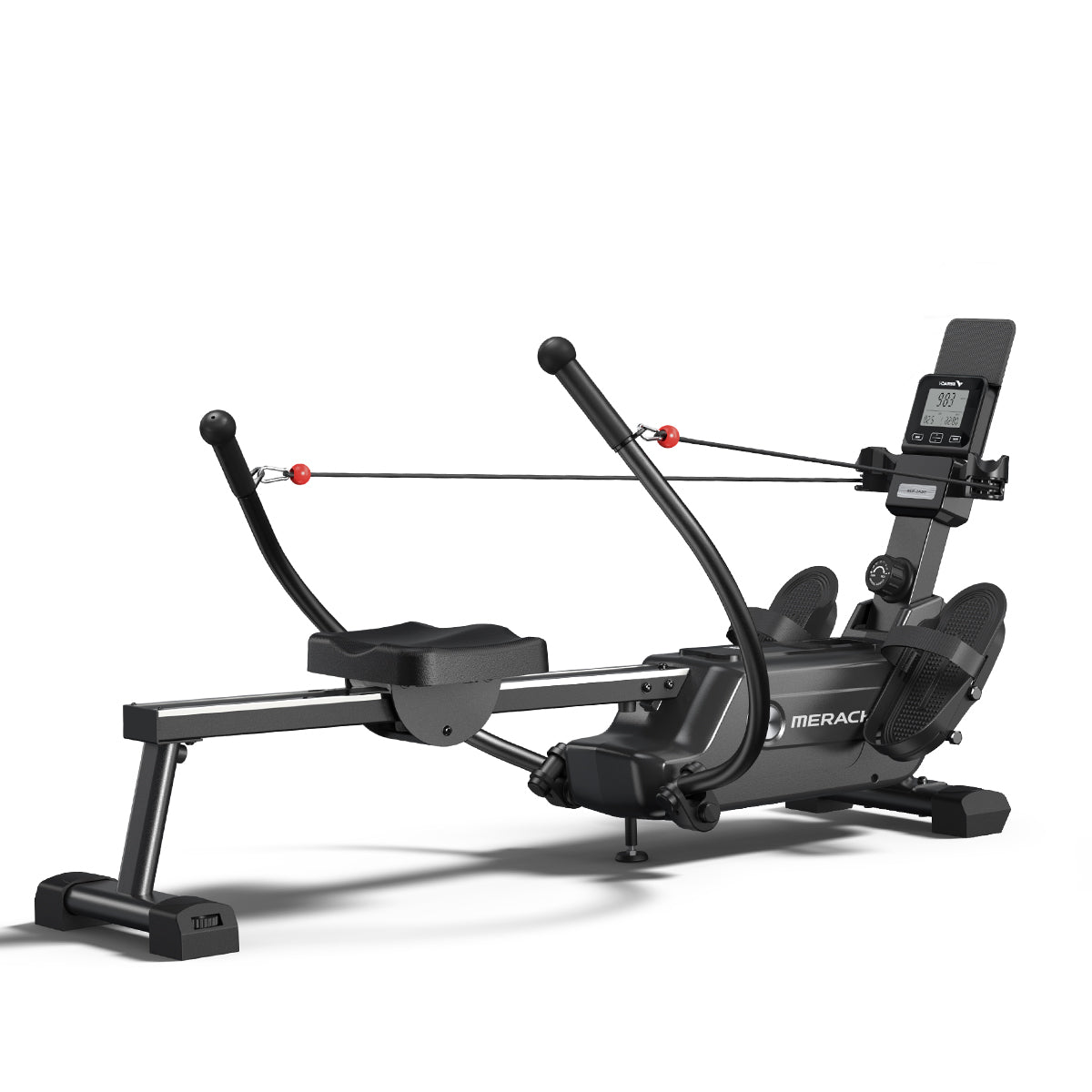
However, not every rowing machine is equally effective for core training. If you want a home rower to perform the above exercises, the Merach NovaRow R50 Air Rower meets all the requirements and stands out from the rest, as this machine is designed for home and commercial use with a realistic experience. It operates with an air-resistance system, which is suitable for users of all levels.
It features 10 levels of air resistance, allowing you to adjust automatically, resulting in core strengthening and calorie burn. With an ergonomic padded seat and adjustable footplates, it ensures comfort for extended sessions. Furthermore, you can connect with the app to track your performance and access workout guides.
5. Things to Avoid While Using a Rowing Machine for Abs
A seasoned exerciser can make mistakes that minimize their core engagement or lead to injury risk. While you are doing your session, make sure to avoid the following mistakes.
- Excessive Back Lean: Leaning too far on your back shifts the focus away from your abs and strains your lumbar spine. Make sure you lean subtly to involve core muscles.
- Sloppy Timing: Ensure that the power comes from the legs first. Yanking your arms prematurely can affect your core engagement.
- Neglecting Recovery: Skipping the cool-down or failing to row at a controlled pace during recovery phases means you miss opportunities for core stabilization work.
- Ignoring Pain: If you feel sharp pain in your lower back or neck, stop and reassess your form. Rowing should feel challenging but not painful.
7. FAQs About Rowing Machines for Abs.
If you want to learn more about using rowing machines for building abs, here are a few common queries that people search for frequently.
Q1: Do I need separate ab exercises if I use a rowing machine?
Rowing provides continuous core activation, but combining it with targeted exercises like planks or leg raises can accelerate results and improve definition.
Q2: What resistance level is best for abdominal engagement?
Moderate resistance with controlled tempo is ideal. Extremely high resistance can shift focus to the legs and arms, while too little resistance reduces core activation.
Q3: Is rowing good for losing belly fat?
Yes, because a rowing machine engages full-body muscles, around 85%, by providing an intense workout that burns calories, and from the belly too. However, you cannot spot reduce fat from your body, as it requires a calorie-deficient diet along with consistent rowing for best results.
8. Conclusion
A rowing machine is actually more than just a cardio machine; with the right technique and training, it will be highly effective to tone your abs while boosting fitness. If you want consistent results at home, explore the Merach NovaRow R50. As you follow the structured workouts, it is recommended to combine them with balanced nutrition, which will help you achieve the best results.